

Industrial robotics and automation
From robotic arms to production cells, understand how robots work in industry.
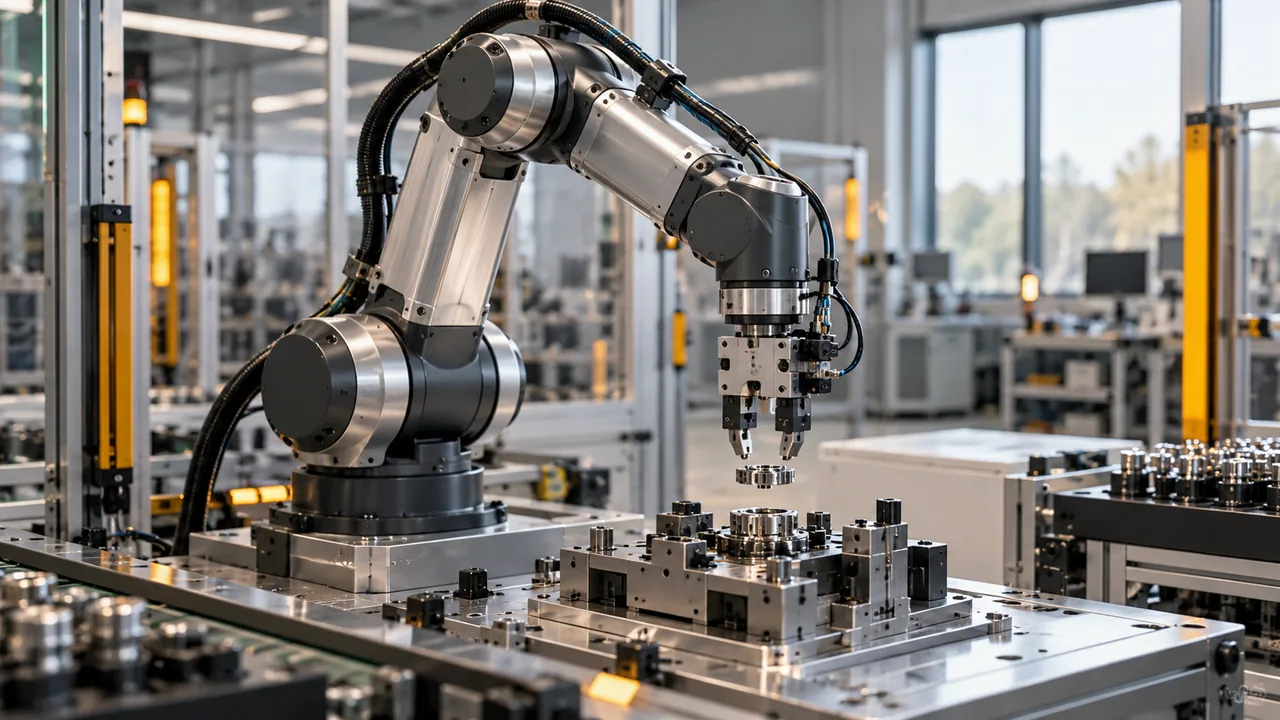
The sub-domains of this page
Industry, logistics, construction, cobotics, and automation.
Producing, assembling, moving goods and building: uses that share methods without all having the same constraints.
Definition and uses
The IFR uses a definition based on a programmable manipulator with several axes, intended for industrial applications. Articulated, Cartesian, SCARA and parallel architectures address different constraints. A robot is only one element of the cell: tools, parts, software and protections also determine its use.
Explore the domain in depth
Applications and technical choices
Assembly, welding, handling, packaging and palletizing are among the uses presented by the IFR. To compare solutions, one must specify the task, the payload handled, the available space and the repeatability sought, rather than comparing only the appearance of the machines.
Collaboration and safety
A collaborative robot does not automatically make an installation safe. The INRS calls for examining the risks related to the robot, the tool, the part and the environment. Prevention is prepared from the integration stage onward and takes work situations into account.
History and lineages
The industrial branch follows the move from programmable manipulators to production cells, then to collaborative uses. Find the benchmarks of industry in the general timeline.
Find this branch in the general tree →Domain news
Robot vision · manufacturer announcementABB: teaching robots to see with AI Robot Trainer
ABB combines image capture, learning and deployment to facilitate industrial vision applications. Our article explains the path from perception to motion and the performance that will need to be verified on the shop floor.
Workshop images → perception model → part localization → robot motion.
Original NewsRobotique educational diagram, simplified.Also in this monitoring
Neuron AI: NEURA combines vision, touch and memory →
To re-read: the global fleet of industrial robots
September 24, 2026 · IFR · professional federationFive million industrial robots in operation in 2025
The IFR publishes its World Robotics 2026 report: the global fleet reaches approximately five million industrial robots in 2025. This sectoral figure describes the installed base, not just annual sales.
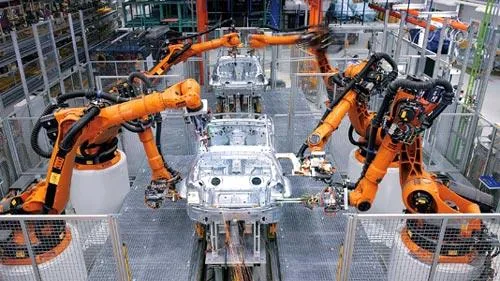
Credit: ISAPUT · 2015 · Original photo ↗ · CC BY-SA 4.0 ↗
Adaptation: resizing and WebP conversion. Images under CC BY-SA retain this license.
Current legal aspect
Machinery, integration and occupational safety
As of 4 October 2026, the transition between the Machinery Directive 2006/42/EC and Regulation 2023/1230 still needs to be anticipated: the regulation applies mainly on 20 January 2027. A collaborative installation also requires a risk analysis.
Professional paths
Choose a path by length of study, then explore the training courses and their institutions. These thematic groupings do not constitute job offers.
Sources and references
References consulted on 4 October 2026.
- IFR — Industrial robots ↗Industry federation
- INRS — Risk identification ↗Occupational risk prevention