They collide, flip over, battle on miniature playing fields, or complete missions entirely on their own. Behind these sometimes spectacular competitions lies far more than entertainment: they are remarkable testing grounds for engineers, students, and robotics enthusiasts around the world.
Sometimes all it takes is a slightly wild idea, a few electric motors, a 3D printer, and a group of enthusiasts to create a genuine technological challenge. What once looked like a game between students and engineers has gradually developed into international competitions with their own rules, referees, teams, and championships. From small sumo robots to impressive combat machines, every confrontation puts months of design, testing, and refinement to the test.
The phenomenon is not new. Robot competitions began gaining visibility in the 1990s, notably through the British television programme Robot Wars and the early events that would lead to BattleBots. In France, the French Robotics Cup has existed since 1994. Today, events such as BattleBots, Makerfight, Eurobot, and RoboCup bring together international communities that do not always share the same rules but pursue a common objective: putting human ingenuity to the test in the real world.
From combat arenas to intelligent playing fields
In the United States, BattleBots is one of the most spectacular showcases for the discipline. Teams from several countries present machines designed to immobilise or disable their opponents in a secured arena. The robots are generally human-controlled, but designing them requires advanced skills in mechanics, power electronics, transmissions, and materials resistance. In 2026, the new BattleBots Pro League brings together 24 robots and teams from countries including the United States, Canada, the United Kingdom, Australia, and Brazil.
At a more accessible scale, the National Havoc Robot League (NHRL) organises tournaments in Connecticut around three main weight classes: 3, 12, and 30 pounds. Entrants must comply with strict technical rules and safety procedures. Before it can even fight, every machine undergoes an inspection covering its weight, electrical shut-off devices, weapon safety, and behaviour if the radio link is lost.
In France, Makerfight perfectly illustrates this culture of experimentation. Created in 2014 within Technistub, a community fab lab in Mulhouse, the tournament invites enthusiasts to build their own combat robots. The 2026 edition took place on 13 and 14 June during the Geek Unchained convention. To make exchanges between European competitors easier, Makerfight brought its rules closer to those of the Fighting Robots Association, particularly for construction and safety requirements. The event is scheduled to return in 2027.
But not every arena is designed to destroy an opponent. Robot sumo is another particularly interesting discipline. The principle is simple: two small machines compete on a circular surface known as a dohyō, with the aim of pushing the opponent outside the ring. Unlike BattleBots machines, these robots can be entirely autonomous. They must detect their opponent, identify the edge of the arena, and adjust their trajectory without any human intervention.
That is precisely the purpose of the SUMOBOT competition, organised in France by the ESIEESPACE student association. With beginner and expert categories, it offers a playful introduction to programming, sensors, and movement strategies. A very fast robot that cannot detect the edge of the ring can therefore lose to a less powerful but better-programmed opponent.
The French Robotics Cup and Eurobot take yet another approach. In the senior competition, robots must complete autonomous missions on a playing table built around a new theme every year. They can manipulate objects, move around, avoid obstacles, and organise their actions to score as many points as possible. The junior version, meanwhile, favours wired robots, allowing participants to learn mechanics and piloting progressively before tackling more advanced autonomy.
The 2026 French edition, held in La Roche-sur-Yon, brought together 154 senior teams, including 35 entered in Eurobot, as well as 38 junior teams. Fifteen nationalities were represented. Teams from Greece, Taiwan, and Serbia reached the podium in the international Eurobot final. It was a concrete illustration of the scale these events have achieved, far removed from a simple competition between school friends.
A real laboratory for tomorrow’s engineers
Behind the spectacle lies a demanding technical reality. Designing a competition robot involves much more than assembling a chassis and a few motors. Teams must calculate mechanical loads, choose a suitable power supply, size the transmissions, design circuit boards, program the controls, and carry out repeated tests. Every gram saved, every improvement in traction, and every millisecond gained in a control loop can affect the result.
The challenge becomes even more interesting when onboard intelligence enters the picture. In autonomous events, robots use their sensors and algorithms to interpret their environment and make decisions. Computer vision, odometry, data fusion, path planning, and sometimes machine learning all become fields to explore. One shortcut should nevertheless be avoided: an autonomous robot does not necessarily use advanced artificial intelligence. A well-programmed set of rules may be enough to win certain events.
Above all, competition confronts theoretical calculations with reality. A motor may overheat, a battery may deliver insufficient voltage, a sensor may produce an incorrect reading, or a 3D-printed part may fail under load. Students from the French ENSMASTEEL club at ISAE-ENSMA experienced this during the 2026 French Robotics Cup, when a failure of their onboard Raspberry Pi immobilised their robot as soon as they arrived. It was a particularly concrete reminder of the importance of testing, reliability, and diagnostics.
The educational value is considerable. Young people learn to solve problems, but also to divide responsibilities, document their choices, manage a budget, and work under time pressure. A university team may bring together specialists in mechanics, electronics, computing, and communication. In 2026, the University of Warwick in the United Kingdom highlighted the work of eight students who entered a 1.5 kg robot competition organised by Bristol Bot Builders. Their team reached the semi-finals of the inter-university tournament.
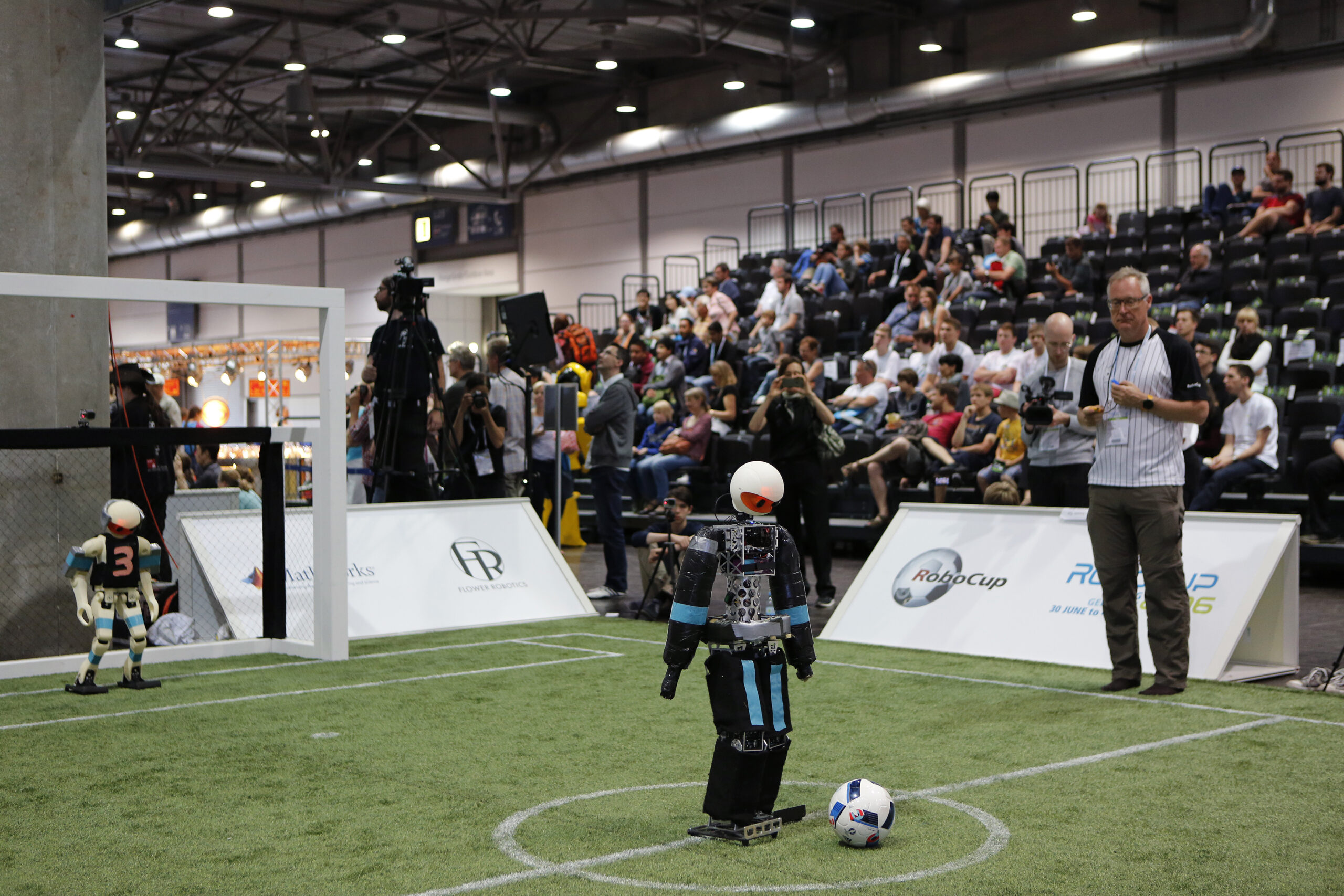
At a higher level, RoboCup turns competitions into genuine research platforms. Since its creation in 1997, it has pursued a long-term goal: developing a team of autonomous humanoid robots capable of defeating the human football world champions by 2050. This remains a scientific ambition, but the work undertaken to approach it involves very real technologies. The competition also includes rescue, domestic robotics, and industrial robotics events in which navigation, manipulation, and cooperation between machines can be evaluated.
However, a technology demonstration should not be confused with industrial validation. Winning a tournament proves that a solution works under the competition’s specific conditions. It does not guarantee that it is immediately suitable for a hospital, a factory, or a rescue mission. Competitions do, however, provide an exceptionally useful environment for testing approaches, comparing architectures, and training the people who will develop tomorrow’s robots.
International events with full competition programmes
Robot competitions have gradually adopted an organisation comparable to that of other sports. Before the matches, teams register, study the rules, and present their equipment. Technical inspections are followed by testing, qualifying rounds, and then elimination matches. Repair workshops come alive between rounds as teams replace a part, check a connection, or correct a program. Visitors can also discover the machines and speak with their designers.
A particularly telling example is the Hack & Make Antweight tournament, scheduled for 31 October and 1 November 2026 in Nuremberg. The robots, limited to 150 grams, must first pass a technical inspection and attend a safety briefing. Matches begin at 11 a.m. on Saturday and continue as qualifying rounds. Sunday is devoted to the remainder of qualifying, followed by the round of 16, quarter-finals, semi-finals, and final. The award ceremony is scheduled for 5:15 p.m. Visitors can therefore watch a genuine miniature championship spread across two days.
In the United Kingdom, Bristol Bot Builders organises regular events in categories including 150 g, 1.5 kg, and 13.6 kg. Some tournaments include inter-university competitions: students face other teams before the best performers move on to the final rounds of the main championship. This mixture of experienced amateurs and engineers in training is one of the most interesting aspects of these events.
For younger participants, events are often accompanied by construction and programming workshops, demonstrations, and exchanges with teams. The journey can begin at a local competition and continue to a national, then international, final. RoboCupJunior disciplines include robot football, simulated rescue missions, and creative robotic performances.
Where can you find clubs and associations to take part?
In France, several organisations offer an introduction to competition, each with its own speciality. Technistub and Makerfight in Mulhouse are a reference for combat robots built by their pilots. ESIEESPACE and SUMOBOT provide a gateway into autonomous sumo. The Nîmes National Robotics Tournament notably develops the practice of mini-sumo. For young people and schools, Planète Sciences runs a network of clubs and regional events. Students can also discover teams such as RobotESEO in Angers, RCVA in Ville-d’Avray, or ENSMASTEEL in Poitiers, all of which compete in autonomous robotics.
Elsewhere in Europe, the network is particularly active. In the United Kingdom, Bristol Bot Builders offers construction guides and a European event calendar. In the Netherlands, Dutch Robot Games organises robot fights and participates in maker events. In Germany, the German Roboteers Association supports several tournaments, including the Nuremberg event. In Italy, I Robottari develops 150 g combat robot competitions and digital manufacturing training. In Spain, COMBATBOTS organises tournaments and provides resources for building a first robot. In Belgium, teams from UMONS take part in Robotix’s, a Eurobot qualifier. These organisations do not all run the same type of competition, but they each provide an entry point into the robotics community.
Across the Atlantic, opportunities are just as numerous. In the United States, NHRL and BattleBots offer two different scales of spectacle and competition. In Canada, BotBrawl brings events and builders together, while Kilobots organises meetings in cities including Calgary and Saskatoon. In Australia, Robowars supports builders and national competitions. All these communities enable participants to put their ideas to the test, share advice, and improve alongside other enthusiasts.
Events to watch
Several events announced for late 2026 and 2027 demonstrate the sector’s international activity. On 31 October and 1 November 2026, Nuremberg’s Hack & Make will host its Antweight robot tournament. On 7 November, Bristol Bot Builders will organise its Beetleweight championship in the United Kingdom, while NHRL will hold a stage of its Pro Tour in the United States. COMBATBOTS plans a tournament in Madrid on 7 and 8 November. The Australian Robowars championships will take place in Brisbane on 28 and 29 November. NHRL has announced its professional world final for 5 December.
In 2027, France will resume its regional Junior Robotics Cup qualifiers in February, before the national and international Eurobot finals scheduled for 5 to 8 May in La Roche-sur-Yon. Belgium will host Robotix’s on 17 and 18 April. Finally, Germany will host the RoboCup World Championship from 15 to 21 June 2027 in Nuremberg, a particularly interesting opportunity to observe advances in autonomous robotics and artificial intelligence. Times, participation procedures, and any calendar changes should still be checked directly with the organisers.
When play becomes a school of innovation
Robot arenas have a rare quality: they make technologies that can be difficult to understand visible and tangible. A child watching a small robot detect its opponent encounters the principles of perception and automatic control, often without even realising it. A student repairing a transmission after a fight immediately understands the limits of materials and the importance of mechanical design.
It would nevertheless be reductive to view these events as simple showcases for industry. Their greatest strength lies in their accessibility and in the freedom to experiment that they give participants. A team can lose a match yet succeed in its project, discover an original solution from an opponent, or leave with a new idea to test.
NewsRobotique’s analysis: robot competitions do not necessarily foreshadow the machines that will equip tomorrow’s factories or homes. But they help train the people who will imagine them. That may be their greatest achievement: turning the pleasure of playing, building, and testing oneself against others into a lasting passion for science and engineering.