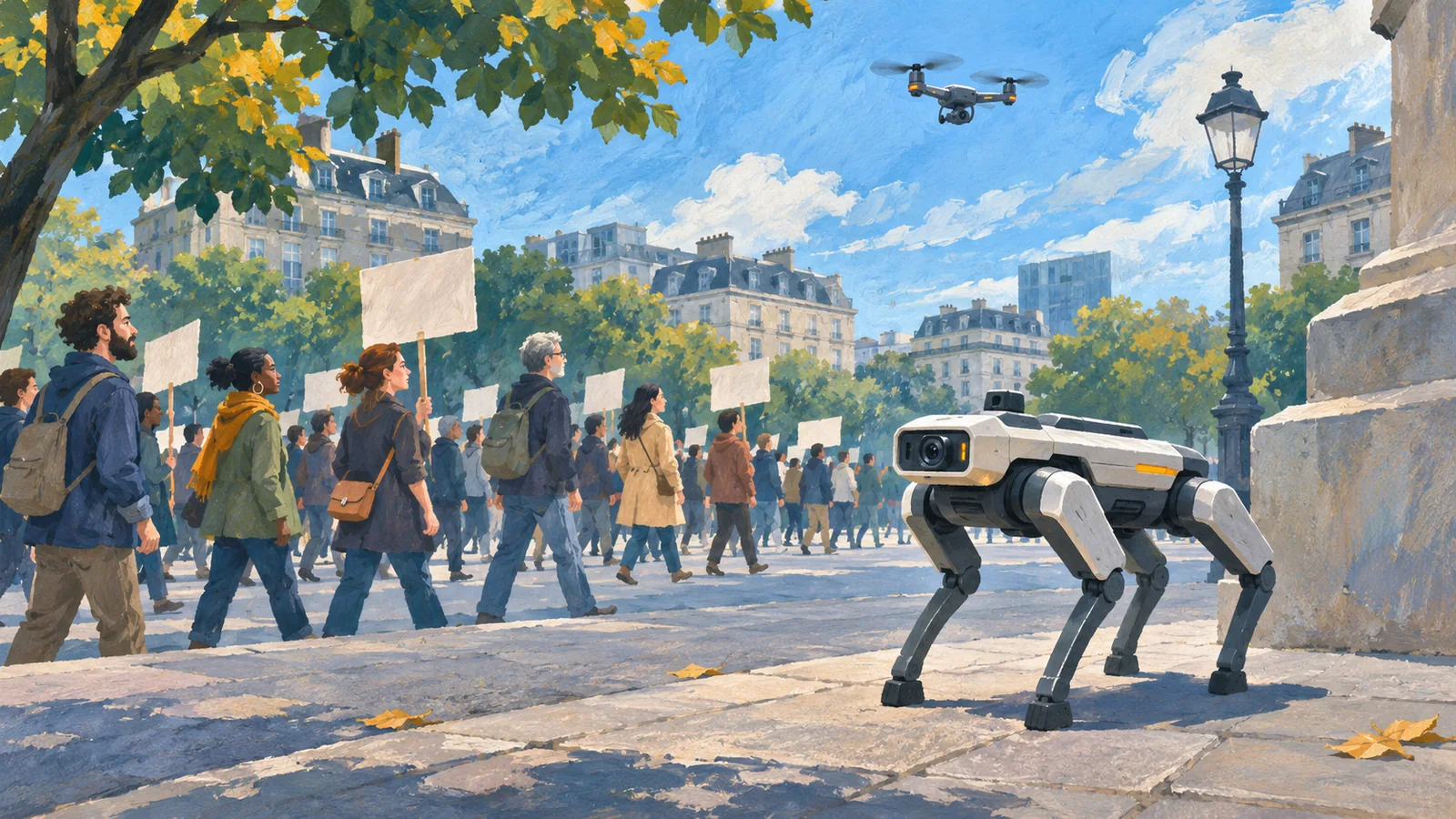
Protests and robots already cross paths in the streets. Drones fly above marches, police use robot dogs, and self-driving cars sometimes become targets. But the gap between actual uses and the image of a robot brigade confronting demonstrators calls for some clear distinctions.
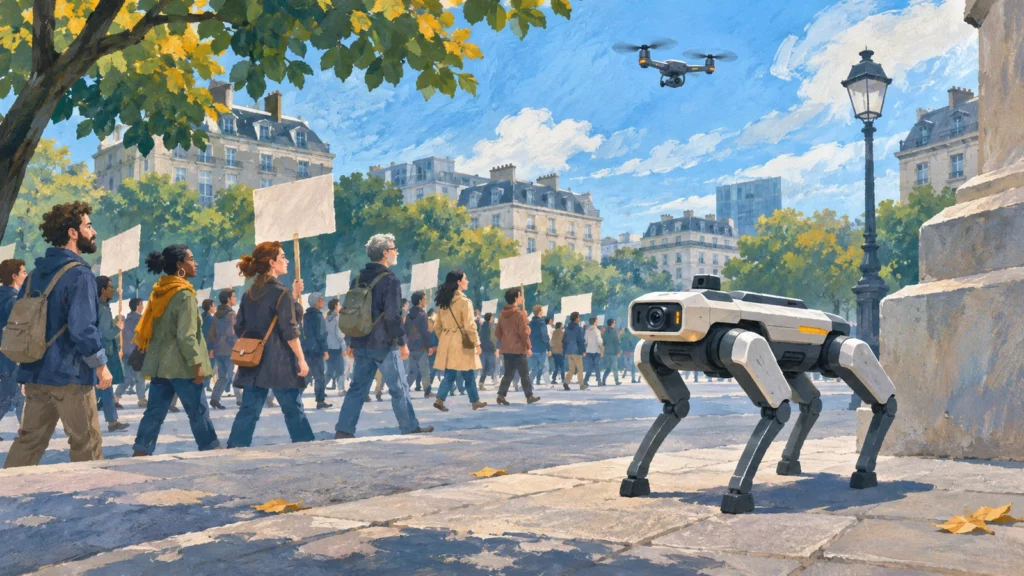
When we imagine robots at a demonstration, one scene readily comes to mind: humanoid machines lined up behind shields, facing a crowd chanting slogans. Documented examples tell a quieter story. Robotics is entering this setting through aerial surveillance, remote observation and, sometimes, the mere presence of autonomous vehicles on streets where a protest is taking place.
To understand what is happening, we need to look at the task assigned to each machine. Filming a march, inspecting a suspicious object and dispersing a crowd are three very different functions. Likewise, a device controlled remotely by an operator does not necessarily make decisions autonomously.
Protests and Robots: The Role of Drones
Drones offer the clearest example of robotic systems associated with demonstrations. In France, their use to monitor gatherings faced legal challenges during the May Day protests in 2023. In Bordeaux, the administrative court rejected a request to suspend the prefectural order authorizing their use. That decision concerned a specific deployment in a particular context. [1]
From the air, these devices provide a broad view of a crowd’s movements. That capability also explains the concerns they raise. France’s data protection authority, the CNIL, outlined the applicable rules in June 2025. It highlights the risks of recording wider areas and potentially tracking large numbers of people, sometimes without their knowledge.
It notes that using these devices for public safety is subject to defined purposes and conditions. The presence of a camera alone therefore does not establish that facial recognition is being used. [2]
Robot Dogs in Police Service
On the ground, robot dogs attract more attention. Their gait resembles an animal’s, while their cameras allow operators to inspect an environment remotely. In April 2023, the New York Police Department announced the return of Digidog, a platform based on Boston Dynamics’ Spot robot. At the announcement, officials described a device remotely controlled by trained officers, intended for hostage situations, bomb threats and other dangerous incidents. [3]
This example shows that robots are already part of some police forces’ equipment. It does not demonstrate that they are used to push back protest marches. That distinction matters whenever a striking photograph circulates: knowing who owns a robot is not enough to establish its mission.
When Robots Become Targets
Machines can also find themselves at the center of a protest without being part of a police operation. On June 8, 2025, a group of people vandalized and set fire to five empty Waymo autonomous vehicles in Los Angeles. This happened near protests against federal immigration enforcement operations. Human Rights Watch reports the episode in its investigation into those events. [4]
These vehicles were robotaxis. Their presence and destruction do not establish any role in monitoring protesters. The episode nevertheless reveals another intersection between robotics and protest: a machine can become a target, or even be perceived as a symbol, regardless of its original function. Assigning a specific motive to each act would require further evidence.
Who Controls the Machine and Answers for Its Actions?
The most sensitive question remains: how far could the use of robotics in crowd control go? Remote observation can spare a person exposure to danger. Giving a machine a means of acting on a crowd raises other issues: the risk of injury, misinterpretation, interrupted communications and the operator’s responsibility.
Manufacturers themselves have taken a position. In 2022, Boston Dynamics and several robotics companies published an open letter opposing the weaponization of their advanced general-purpose mobile robots. The pledge also covers the robotics software they develop. The signatories commit not to weaponize these technologies or support others in doing so. This industry commitment applies to their products; it does not amount to a universal ban on armed robotics. [5]
When images of robots in the street appear, a few questions help establish the facts: where and when was the scene filmed? Was it a demonstration of the technology or an actual operation? Who controls the device? What is it really doing? An imposing silhouette tells us little about a machine’s level of autonomy or the powers entrusted to it.
Yes, robots already cross paths with protests. Documented examples mainly show observation tools, specialized response equipment and autonomous vehicles caught up in events. Their future role will depend on permitted uses and institutional choices. As these machines move closer to crowds, one requirement becomes central: being able to identify who controls them, who decides their mission and who answers for their actions.
Further reading: what distinguishes a robot from an object paired with AI?