What if, tomorrow, your refrigerator, desk lamp or even your furniture became a robot? Artificial intelligence is steadily moving into everyday objects, enabling them to make decisions without human intervention. But is adding autonomous AI to a device enough to turn it into a robot? Behind this apparently simple question lies an increasingly important scientific boundary.
Only a few years ago, the distinction seemed obvious. On one side were robots: machines capable of moving, assembling parts or handling objects. On the other were electronic and computer-based devices whose operation still depended largely on predefined programs or human commands. Today, that separation is becoming less intuitive. A car can analyse its surroundings, a camera can identify suspicious behaviour and a refrigerator can anticipate some of its user’s needs.
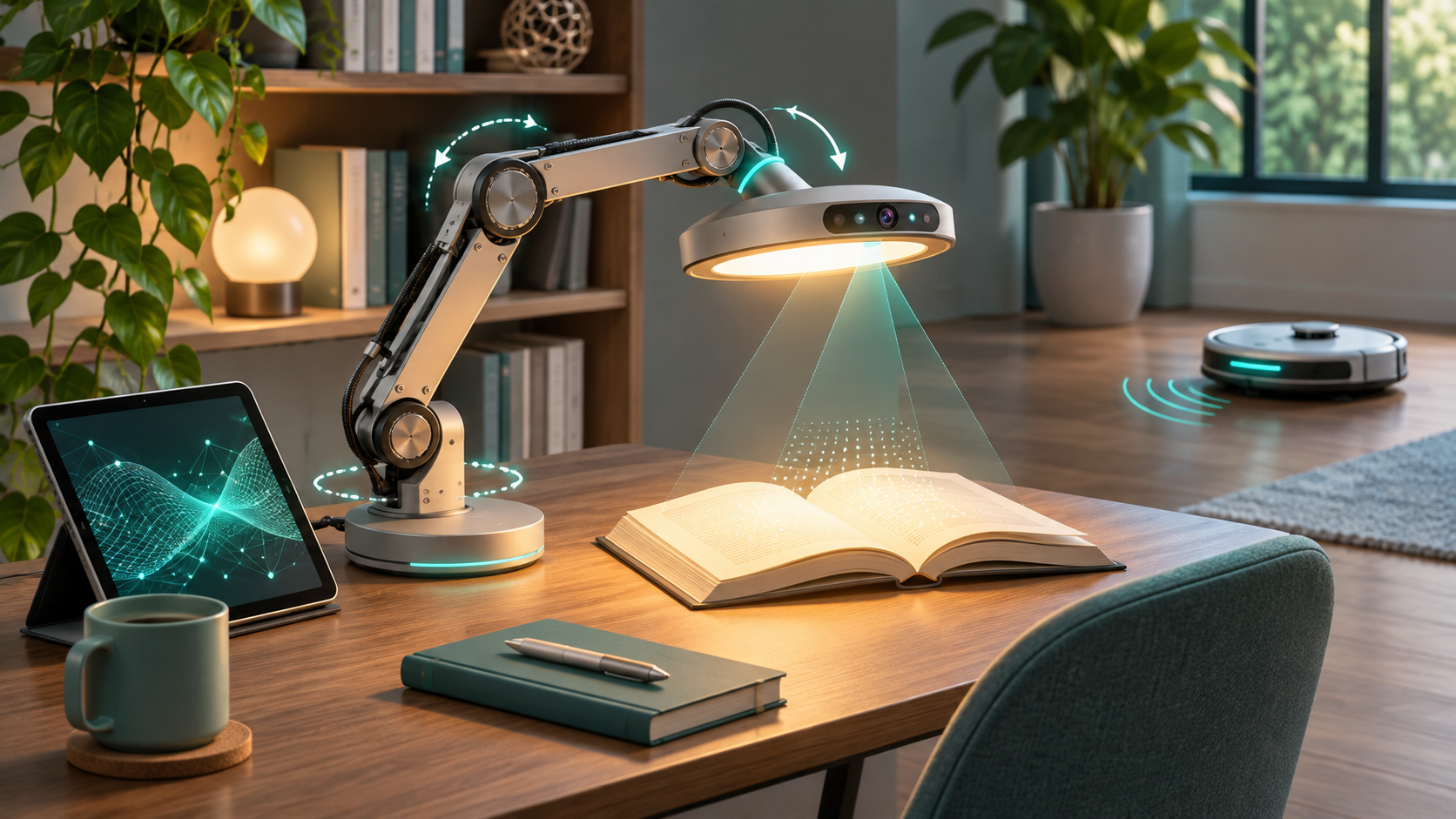
Now imagine a simple desk lamp equipped with artificial intelligence. It recognises its user, analyses their habits, automatically adjusts its brightness and can even anticipate their needs. Has it become a robot? What if the same lamp had an articulated arm that allowed it to turn by itself towards a book or a face?
The difference may seem subtle, but it is fundamental: a machine capable of making decisions is not necessarily a robot. When it can also act physically on its environment, however, we enter the field of robotics.
What actually defines a robot?
Contrary to the popular image of the humanoid robot, robotics does not require any particular appearance. A robot may have legs, wheels or articulated arms, or remain fixed to the floor.
The international standard ISO 8373:2021, which covers robotics vocabulary, defines a robot as an actuated and programmed mechanism with a degree of autonomy for carrying out locomotion, manipulation or positioning.
That definition highlights three essential features: a physical mechanism, the ability to act and a degree of autonomy. In other words, robotics cannot be reduced to the presence of a computer, intelligent software or sophisticated sensors.
Artificial intelligence is defined differently. The European Union’s AI Act describes, among other things, systems capable of producing predictions, recommendations, content or decisions from the information they receive, with the potential to influence a physical or virtual environment.
An AI system can therefore operate perfectly well without ever moving an object.
Consider a conversational assistant capable of organising our day, analysing documents and managing certain software. It may enjoy considerable autonomy in its digital tasks, but that does not make it a robot in the mechanical sense.
AI produces decisions or information. A robot has the physical means to carry out actions. The two technologies can work together, but neither depends on the other.
From connected object to robot: where is the boundary?
Let us look at a few everyday devices.
A smart refrigerator can monitor its temperatures, analyse its electricity consumption and suggest a shopping list. Even when equipped with autonomous AI, it remains primarily a smart household appliance. Its ability to interpret data is not enough to make it a robot.
A robot vacuum is a very different case. It moves, uses sensors to find its way, adapts its route and physically performs a task. Some models use LiDAR to map rooms, while others include object-recognition algorithms. A robot vacuum therefore combines perception, control and mechanical action.
Our lamp is a more interesting example. If it merely adjusts its lighting to suit the user, it would be better described as a smart device. If it has a motorised articulated structure capable of automatically repositioning its beam to follow a person, however, it begins to resemble a robotic mechanism. Depending on its design and its actual level of autonomy, its classification may become debatable.
Furniture offers another experimental field. Ori has developed motorised systems that can transform the layout of a home, for example by moving a structure to change how a room is used. These solutions show that an apparently ordinary object can incorporate robotic technology without looking like a conventional robot. A note of caution is needed, however: a piece of furniture that moves when a button is pressed is not automatically an autonomous robot.
This reveals an important limit. Not every device that moves is necessarily a robot. An automatic door, a motorised blind or a programmed coffee machine can perform physical actions without invariably deserving that classification.
The distinction depends in particular on the nature of the mechanism, its functions and the way in which it carries out its tasks.
Does a robot really need artificial intelligence?
This may be the most interesting paradox in this technological evolution: an AI-enabled object is not necessarily a robot, and a robot does not necessarily need AI.
In industry, robots have spent decades performing welding, assembly and handling operations using deterministic programs. They follow trajectories, control their motors and may react to sensors without necessarily using machine learning.
The International Federation of Robotics (IFR) also points out that some manipulation and movement applications can operate without artificial intelligence.
Autonomy should therefore not be confused with AI. A robot can complete its mission without human intervention by applying conventional control and navigation rules.
AI adds value instead through its ability to handle more complex situations: recognising unfamiliar objects, interpreting a naturally worded instruction, planning a sequence of actions or adapting its behaviour when its surroundings change.
This combination is paving the way for new generations of versatile robots.
Embodied AI: when digital intelligence meets the physical world
Researchers increasingly use the term embodied AI. It refers to approaches in which intelligence interacts with a physical environment through a robotic body, sensors and actuators.
This goes well beyond simply installing a voice assistant on a machine.
In March 2025, Google DeepMind introduced Gemini Robotics, a family of models designed to connect visual and language understanding with robot actions. In July 2026, the company announced Gemini Robotics 2, with a particular focus on whole-body coordination, manipulation and collaboration between robots.
The aim is to enable machines to perform a wider range of tasks by combining an understanding of their environment with appropriate motor commands.
Caution is still required: performances demonstrated in the laboratory do not mean that all these systems can operate freely in a home, factory or hospital. Reliability, mechanical constraints and safety remain decisive.
Another major development concerns where the intelligence is located. A robot can receive decisions from a remote, cloud-hosted AI system. Its intelligence does not therefore have to be installed entirely within its chassis. What matters when classifying a device as robotic remains the presence of a mechanism capable of acting with a degree of autonomy.
What if our entire home gradually became robotised?
Imagine a home in which artificial intelligence coordinates the lighting, windows, doors, heating, household appliances and several items of motorised furniture.
The system could analyse the occupants’ habits and automatically adapt some of the building’s functions.
Should the home then be regarded as one enormous robot?
Not necessarily. We would first describe it as a smart building, advanced home-automation system or cyber-physical system: an ensemble combining computing with physical processes. Some of its devices might individually be robots or robotic mechanisms without the entire home automatically becoming a robot under the ISO definition.
The distinction could nevertheless become increasingly difficult if mobile components, manipulator arms and autonomous systems worked together to carry out complex physical tasks.
A new question would then arise: where does the smart object end and the robotic system begin?
That question leads to others. How can we ensure that a decision made by AI does not trigger a dangerous movement? What happens if the network connection is interrupted? How can people retain control of mechanisms when the software changes independently of the hardware?
Cybersecurity, reliability and human oversight become particularly sensitive issues as soon as a digital decision can have a physical consequence.
NewsRobotique’s analysis: it is not AI that makes a robot, but the ability to act
Artificial intelligence is transforming our relationship with machines, but it is not enough to erase every technical distinction. Adding autonomous AI to an object gives it neither new mechanical abilities nor, automatically, the status of a robot.
The real evolution may come from combining three elements: intelligence capable of understanding a situation, mechanisms capable of acting and sufficient autonomy to connect the two.
As motors become more compact, sensors improve and AI models become widespread, objects that were previously passive may acquire robotic functions. Furniture, healthcare equipment and some domestic installations could therefore enter a field long reserved for specialised machines.
The question may no longer be simply whether an object has artificial intelligence, but what it is actually capable of doing with it.
Ultimately, what turns an object into a robot is not simply its ability to make a decision, but the way that decision becomes an autonomous mechanical action in the real world.