What if tomorrow’s robots were made from plants, natural proteins, or even food waste? Long dominated by metals, plastics, and electronic components, robotics is now exploring a new path: bio-based materials. Some companies are beginning to turn this idea into practical technologies, while laboratories are producing a growing number of demonstrations. But who are the true pioneers in this field, and what could their innovations be used for?
When nature becomes a raw material for robots
In simple terms, bio-based robotics uses materials derived from renewable biological resources to manufacture certain robot components. These may include cellulose extracted from wood, polymers produced by microorganisms, natural proteins, plant oils, or by-products of animal origin.
However, two approaches that are often confused must be distinguished. Bio-inspired robotics reproduces mechanisms found in living organisms, such as an octopus’s tentacles or human muscles, without necessarily using biological materials. Bio-based robotics focuses directly on the origin of the materials employed. The two approaches can come together in soft robotics.
This distinction is essential for understanding a market that is still in its infancy. In 2026, companies able to commercialize fully bio-based robots remain rare. Innovation is primarily concentrated on artificial muscles, soft grippers, smart polymers, and biodegradable components.
The companies leading the way
In Canada, Bioastra is one of the most interesting companies to watch. Based in Montreal, the company develops polymers that can change their properties in response to different stimuli. Its BIOELASTX platform uses renewable elastomers, while BIODEXTER explores soft actuators, adaptive gripping systems, and haptic feedback. Another platform, BIONAUTIX, is dedicated to deployable structures that use bio-based and biodegradable materials, among others.
The value of this research goes beyond simply replacing plastic. By designing materials able to change shape, stiffness, or behavior, Bioastra aims to build certain mechanical functions directly into the material. In time, this approach could simplify the design of robotic grippers, soft medical devices, or miniaturized structures. The company already markets some polymer solutions, but its various robotics platforms should not be regarded as fully commercialized industrial robots.
In the United States, Artimus Robotics, based in Boulder, Colorado, develops electrohydraulic artificial muscles known as HASEL actuators. These actuators convert electrical energy into movement and could enable softer, quieter machines capable of motions closer to those of living organisms.
A study published in Science Advances in 2023, involving researchers connected with the founders of Artimus Robotics, demonstrated that biodegradable HASEL actuators could be manufactured using suitable polymer films and gelatin-based electrodes. The experimental devices exceeded 100,000 actuation cycles, with one demonstration featuring a gripper handling lettuce. Artimus sells conventional HASEL actuators and continues to develop them, but there is no established evidence that this biodegradable version is commercially available.
Another company to follow is Smart Resilin in Israel, which is working with a particularly surprising raw material: resilin, a protein naturally found in certain insects and known for its elasticity. Using biotechnology and microbial fermentation, the company aims to produce this protein as a replacement for some synthetic polymers.
Potential applications include flexible coatings, elastic materials, and soft robotics. The aim would be to develop highly deformable components from biological resources. Smart Resilin nevertheless remains a biomaterials company in the development phase, not a manufacturer currently offering a range of bio-based robots.
What about France? In the Hauts-de-France region, Compliance Robotics, which grew out of research associated with Inria, illustrates the country’s strength in soft robotics. Its Hollow industrial arm is designed to work alongside operators, particularly when handling food products and sorting waste. Its Emio educational platform also uses PLA components, a polymer that can be produced from renewable resources.
It would nevertheless be inaccurate to describe all of its machines as bio-based. The company is primarily an example of commercially viable soft robotics whose architectures could, in the future, benefit from the arrival of new renewable materials.
From food production to medicine: practical applications are emerging
The food industry is one of the most promising fields. Industrial robots sometimes need to handle fruit, vegetables, or other delicate foods without crushing them. Soft grippers made from materials of biological origin could offer an alternative to certain synthetic components, provided that they meet hygiene, durability, and food-safety requirements.
A study published in late 2025 in the International Journal of Biological Macromolecules presented 3D-printed actuators made from fish gelatin and gellan gum. These experimental devices can grasp foods of different shapes, and the researchers observed their biodegradation under defined test conditions. This was a scientific advance, not yet a solution deployed on a large scale in factories.
Medicine is a second major avenue. Soft robotic devices that may be biocompatible or resorbable could one day operate temporarily inside the body, deliver substances, or perform certain procedures before being removed or breaking down under controlled conditions. These possibilities will, however, require rigorous scientific, clinical, and regulatory validation.
Environmental protection is also opening up new possibilities. In 2026, a paper in Nature Sustainability presented biodegradable robotic fingers able to withstand more than one million actuation cycles, with embedded electronic components that enabled them to sense their environment. The researchers demonstrated experimental interventions on plants, among other uses. This performance suggests that a degradable component is not necessarily synonymous with a fragile or single-use mechanism.
Europe experiments with robots made from food waste
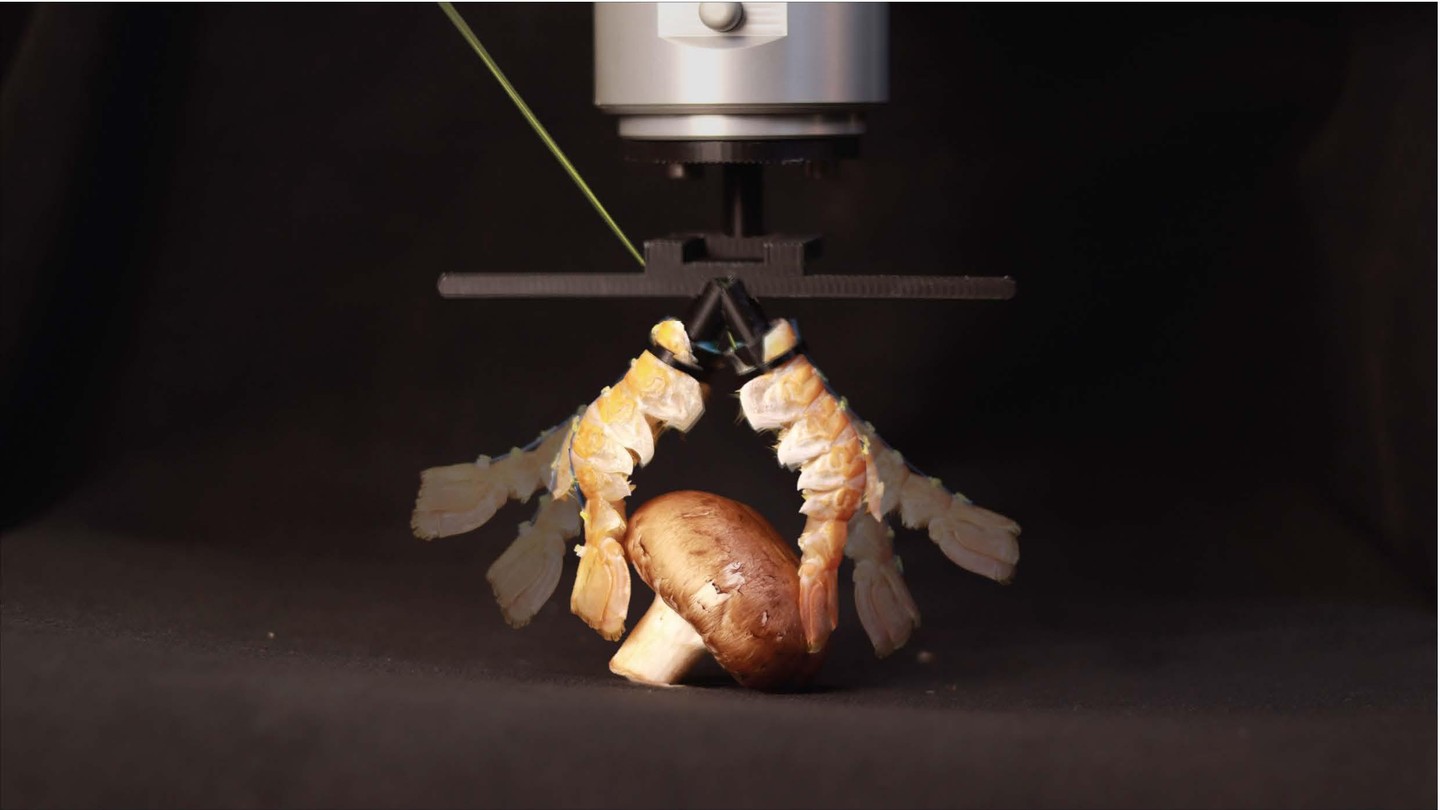
In December 2025, the Swiss Federal Institute of Technology Lausanne (EPFL) presented a particularly original experiment. Its researchers reused langoustine shells from the food industry to manufacture robotic components.
Combined with actuators and synthetic components, these natural structures were used to create a gripper, a manipulator capable of moving objects weighing up to 500 grams, and a small aquatic propulsion system. The idea is to make direct use of the mechanical properties of an existing biological structure rather than manufacture its artificial equivalent from scratch.
Another European program, RoboFood, coordinated by EPFL and completed in September 2025, went even further by exploring edible robotics. Its researchers designed demonstrators ranging from a partially edible drone intended for rescue scenarios to mobile feeding devices for fish. The program also investigated edible batteries and actuators. These innovations remain experimental but could open up applications in rescue operations, aquaculture, and, in the longer term, certain medical devices.
Greener robots—but under what conditions?
Manufacturing a component from a renewable resource does not automatically guarantee a better environmental footprint. A bio-based material is not necessarily biodegradable, and a biodegradable material does not inevitably disappear in nature. Some polymers, including certain PLA formulations, require specific industrial conditions to be composted.
Manufacturing processes, energy consumption, electronic components, batteries, and machine lifespan must also be considered. Replacing a durable plastic part with a biological component that needs to be replaced much more frequently could even result in a worse overall impact.
The real challenge is therefore to combine performance, longevity, repairability, and end-of-life recovery. The next steps will probably be less spectacular than a fully plant-based robot, but perhaps more useful: gradually replacing consumable parts, coatings, or certain actuators with alternatives better suited to a circular economy.
The NewsRobotique analysis
Bio-based robotics is no longer merely a laboratory curiosity. Several companies are now working on biological raw materials capable of performing functions previously reserved for conventional polymers. Yet the market remains at an early stage, and scientific demonstrations should not be confused with mature industrial production.
The future of this field will depend not only on our ability to build robots from living-derived materials, but above all on our ability to prove that those materials are reliable, economically accessible, and genuinely less polluting throughout their life cycle.
Tomorrow’s robot may not be entirely biodegradable. But some of its parts could already be designed to return to the material cycle rather than become yet another piece of waste.
Scientific and industry sources: Bioastra · Artimus Robotics · Study on biodegradable HASEL actuators, Science Advances, 2023 · EPFL, shell-based robots, 2025 · Nature Sustainability, biodegradable robotic fingers, 2026 · European Commission, RoboFood project.
NewsRobotique.com — Bio-inspired Robotics & Soft Robotics feature