Artificial muscles made from gelatin, edible aquatic robots, and robotic fingers able to operate more than one million times before being composted: biodegradable robotics no longer belongs solely to science fiction. Several scientific teams have recently taken important steps toward machines whose components—and in some cases entire systems—can break down after use. But is this technological revolution truly environmentally friendly, and which applications could it transform?
A new generation of robots designed to leave almost no trace
In March 2026, an international team led by Seoul National University, working with researchers in Austria and the United States among others, presented a remarkable innovation in Nature Sustainability: soft robotic fingers able to withstand more than one million actuation cycles while being designed to degrade after use. The researchers even integrated biodegradable electronic components that allow the devices to sense their environment.
This advance addresses a growing problem. Robots today contain metal alloys, synthetic polymers, electronic circuits, and sometimes batteries that are difficult to separate and recycle. The miniaturization of some systems, particularly in medical and environmental robotics, makes end-of-life recovery even more complicated.
The objective is not, however, to build fragile robots or encourage disposable machines. The scientific ambition is precisely the opposite: to develop systems that remain sufficiently capable and durable throughout their useful life, after which their components can be treated biologically under controlled conditions.
Several terms must not be confused. A bio-based material comes wholly or partly from biological resources, but is not necessarily biodegradable. A biodegradable material can be broken down by microorganisms under certain conditions without necessarily being plant-derived. A compostable material must meet requirements concerning degradation and compost quality in a specific environment.
Finally, a biodegradable robot is not automatically edible. These properties can overlap, but they respond to different requirements. This distinction is essential when assessing innovations promoted as environmentally friendly.
From gelatin to artificial muscles: a decade of ideas taking shape
In February 2022, scientists at Johannes Kepler University Linz in Austria published a study in Science Robotics on 3D-printing soft robotic components from biogels.
Their material, based in part on gelatin, could stretch to six times its original length. With a suitable printing technique, the researchers produced pneumatic actuators capable of deforming in multiple directions and responding in less than a second. Soft optical waveguides also made it possible to detect certain changes in shape and the presence of obstacles.
The innovation therefore lay not only in the materials selected, but in their ability to perform mechanical and sensory functions at the same time. The printed elements could also be reprocessed to manufacture new components, an interesting prospect for reducing waste from prototyping.
A year later, in March 2023, another collaboration involving the Max Planck Institute for Intelligent Systems, Johannes Kepler University, and the University of Colorado Boulder took the next step. In Science Advances, the researchers presented biodegradable electrohydraulic artificial muscles based on HASEL technology.
The principle is ingenious: a soft polymer membrane contains an insulating liquid. When an electric field is applied to the electrodes, the redistribution of the liquid creates mechanical deformation. The device contracts and produces a movement broadly comparable to that of a muscle.
The researchers replaced several conventional materials with biodegradable polymer films, ester-based dielectric liquids, and electrodes containing gelatin and salt, among other ingredients. The experimental actuators exceeded 100,000 operating cycles without an observed electrical failure under the test conditions.
To demonstrate their usefulness, the team developed a robotic gripper able to handle objects, including lettuce, and compatible with a commercial robotic arm. It is important to note, however, that biodegradable actuators do not make the industrial arm to which they are attached biodegradable.
The next milestone came in February 2025 from a team at Westlake University in China. Its researchers developed an origami-inspired soft robot from cellulose films and gelatin-based conductive gels. These materials were used both to construct some of the mechanical structures and to detect their deformation. The goal was to combine the functions of a teleoperated robot with materials that could be reused or degraded after use.
Three publications, three different advances, but one common direction: gradually replacing persistent components with materials whose mechanical properties and end of life can be controlled.
2026: compostable robotic fingers exceed one million cycles
The study published on March 5, 2026 in Nature Sustainability marks an important step forward. Researchers at Seoul National University and their partner institutions developed robotic fingers from a biodegradable elastomer known as poly(glycerol sebacate), or PGS.
This material has a property that is essential in soft robotics: it can deform and then repeatedly return to its original shape. During testing, the actuators exceeded one million cycles without a major loss of mechanical performance.
But the innovation goes further. The researchers combined these structures with transient electronic components using magnesium, molybdenum, and silicon, among other materials. The system integrates 21 electronic components that perform a range of functions: detecting touch; measuring temperature, humidity, pH, curvature, and strain; and providing local heating, electrical stimulation, and the controlled release of substances.
The demonstrations included a soft gripper able to interact with plants, collect certain measurements, and perform experimental interventions on leaves.
The researchers also subjected the devices to industrial composting conditions. Their structures and integrated electronic components broke down over a period of several months. Oat-germination tests in substrates containing the breakdown products did not reveal a toxic effect under the conditions studied.
This result is particularly interesting because it addresses the three historical challenges of the technology at the same time: operating life, electronic integration, and management of end-of-life residues.
Caution is nevertheless required. One million cycles achieved in a laboratory do not guarantee the same lifespan under every industrial condition. Similarly, germination tests do not universally demonstrate safety for all soils, organisms, and ecosystems. These results concern an experimental platform, not a commercial agricultural robot.
Robots that fish could eat: Switzerland’s surprising approach
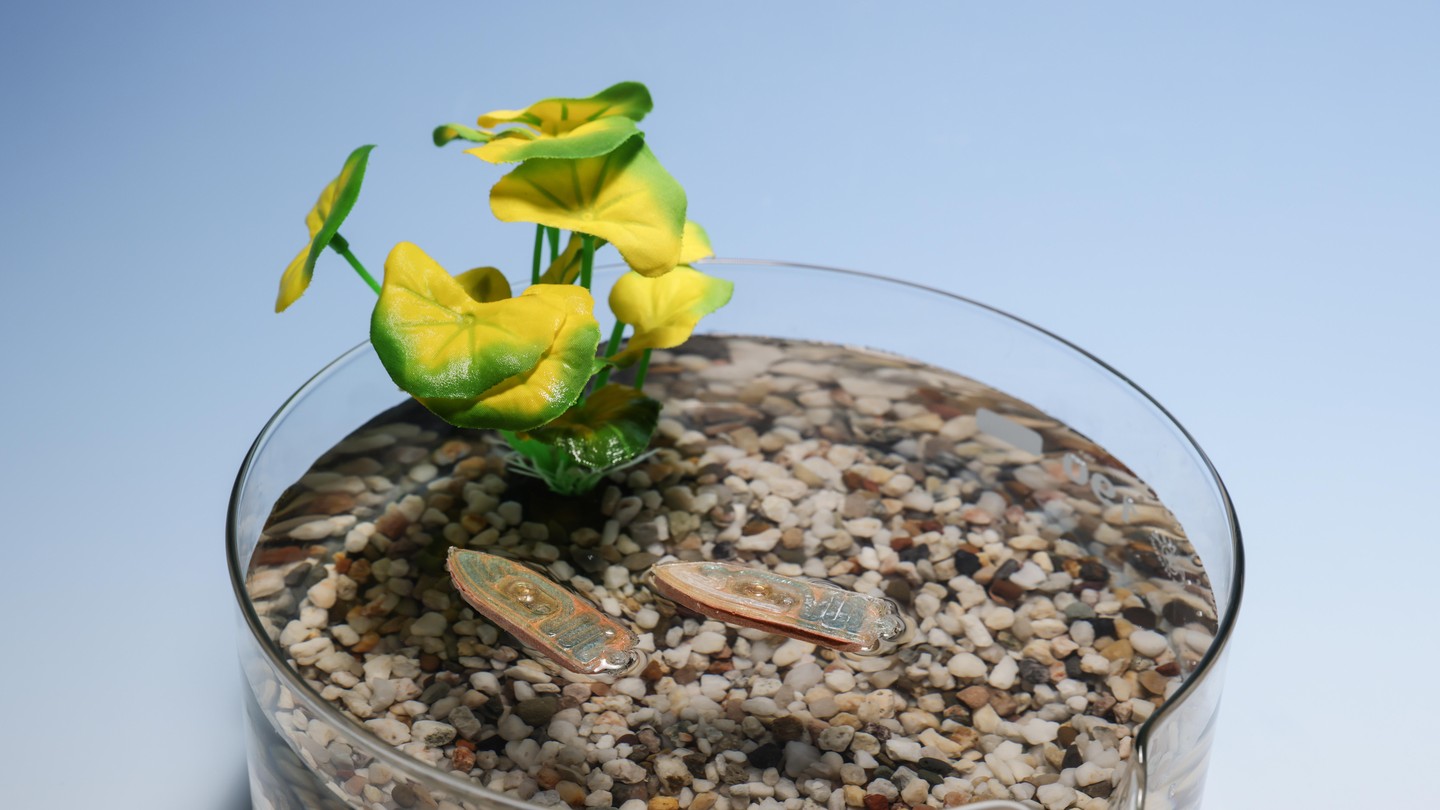
Biodegradable robotics is also exploring much more unusual avenues. In May 2025, the Intelligent Systems Laboratory at the Swiss Federal Institute of Technology Lausanne (EPFL), working with Wageningen University in the Netherlands, presented in Nature Communications a small aquatic robot made from fish food.
Roughly five centimeters long, the device resembles a tiny boat. Unlike a conventional underwater robot, it uses neither a conventional electric motor nor a battery to move. Its motion is based on the Marangoni effect, a physical phenomenon caused by differences in surface tension across a liquid.
In practical terms, when the robot comes into contact with water, a reaction between citric acid and sodium bicarbonate produces gas. This gradually pushes a liquid—propylene glycol—toward the rear of the device. The resulting local change in surface tension propels it forward.
The robot can move for several minutes. Its structure, made primarily from food-grade materials, is designed to be biodegradable and edible for certain aquatic species.
EPFL ultimately envisages using similar systems to monitor sensitive natural environments, distribute food, or carry useful substances. However, the prototypes presented in 2025 do not yet perform complete environmental monitoring; integrating biodegradable sensors remains a proposed future development.
In September 2026, another EPFL paper in Advanced Materials Technologies added a further piece to the puzzle. Researchers produced biodegradable and edible fluidic logic circuits from valves that use gelatin, among other materials. These circuits perform elementary logic functions at low pressure without requiring the same electronic architectures as conventional computers.
Over the longer term, this kind of research could make it possible to design devices that respond to stimuli and control certain actions using degradable materials. We are nevertheless still a long way from an autonomous robot with computing capabilities comparable to those of an embedded computer.
Explore the guide to drones and exploration robotics
Agriculture, medicine, and the environment: the most promising applications
The first applications could emerge in sectors where small robots are difficult to retrieve, where some parts must be replaced regularly, or where materials come into direct contact with living organisms.
In agriculture, biodegradable soft grippers could provide alternative components for handling certain delicate fruits and vegetables. Temporary sensing and monitoring devices are another interesting possibility, particularly when they are used for a limited period. Adoption will nonetheless depend on their weather resistance, cost, and the real effects of their degradation in soil.
The medical field may offer even greater potential. Some temporary devices could be designed to degrade inside the body after completing their task, without systematically requiring another procedure for removal. Miniaturized drug-delivery mechanisms, stimulation systems, and diagnostic devices are all being considered. These remain research avenues, however: using them in people will require extensive studies of biocompatibility, safety, and effectiveness.
Environmental monitoring could benefit from small systems that operate temporarily in sensitive areas. Edible aquatic robotics illustrates this possibility, but it also raises a fundamental question: even if a device is biodegradable, should machines deliberately be dispersed in nature? The answer will depend on their composition, the number deployed, and the environmental consequences of their use.
Finally, industry could progressively integrate actuators, casings, soft structures, and other replaceable parts made from biodegradable materials. This scenario appears more immediately plausible than a factory using entirely compostable robots.
Explore the guide to agricultural robotics
A genuinely environmental solution—or a new form of greenwashing?
The expression “biodegradable robot” might suggest a machine that can simply be abandoned in a garden and disappear without consequence. The reality is considerably more complex.
The speed and extent of biodegradation depend on the material, temperature, humidity, presence of microorganisms, and the surrounding environment. A component that can be industrially composted will not necessarily decompose in a home compost heap, much less in a river or the ocean.
The European Commission also stresses the need to distinguish between bio-based, biodegradable, and compostable materials. Industrial compostability requirements, such as those set out in the EN 13432 standard for packaging, do not amount to a general certification for an entire robot.
Electronic components, adhesives, coatings, fluids, and any batteries present another difficulty. For a system to be genuinely biodegradable, every component must be examined. A robot equipped with a compostable gripper still generates electronic waste if the rest of the machine must be processed through conventional disposal streams.
The environmental assessment must also include manufacturing. A renewable component that requires a great deal of energy to produce, or that must be replaced much more often than a conventional part, will not necessarily offer an overall advantage. Life-cycle assessments will need to compare energy use, raw materials, emissions, longevity, and opportunities for reuse.
Finally, biodegradability should not become a justification for single-use products. In many situations, keeping a durable, easily repairable, and recyclable machine will remain preferable to repeatedly manufacturing robots designed to disappear.
The NewsRobotique analysis: the robot of the future must also end its life responsibly
Biodegradable robotics is making genuine scientific progress. In only a few years, researchers have moved from experimental structures printed from biogels to systems with durable artificial muscles, integrated sensors, and even logic functions made from degradable materials.
The year 2026 marks another milestone with the demonstration of compostable robotic fingers exceeding one million cycles. These results do not, however, mean that fully biodegradable industrial robots are ready to replace today’s machines. Long-term reliability, energy supply, environmental safety, and industrial cost remain major obstacles.
The real future of this technology may lie in a hybrid approach: retaining durable, repairable elements while replacing certain consumable or hard-to-recycle parts with alternatives whose end of life can be controlled.
The challenge is therefore not simply to build robots that can disappear, but to design machines that leave as few consequences as possible behind them. After decades spent making robots ever more durable and intelligent, engineers must now consider what becomes of them once their mission is complete.
NewsRobotique.com — Scientific feature, Bio-inspired Robotics & Soft Robotics.
Scientific sources
- Heiden et al., Science Robotics, 2022 — 3D-printing biogels for robotic actuators.
- Rumley et al., Science Advances, 2023 — Biodegradable electrohydraulic actuators.
- Wei et al., Science Advances, 2025 — Biodegradable origami robotics.
- Zhang et al., Nature Communications, 2025 — Edible aquatic robots.
- Kim et al., Nature Sustainability, 2026 — Biodegradable robotic fingers.
- Zhang et al., Advanced Materials Technologies, September 2026 — Edible fluidic logic circuits.
- European Commission — Policy framework for bio-based, biodegradable, and compostable plastics.