
The official store now announces 4 to 6 months for new orders and no longer promises delivery for Christmas. The headline raises the question of a trend; it does not guarantee the robot’s availability for the holidays.
More than 20,000 pre-orders announced. That is the figure put forward by Clément Delangue, head of Hugging Face, after a remarkable demonstration of Microduck at the NVIDIA GTC conference in Berlin, in October 2026.
On stage, several small duck robots performed a series of movements, acrobatics, and sound effects before the eyes of Jensen Huang, CEO of NVIDIA. The footage, widely shared on social media, immediately attracted attention.
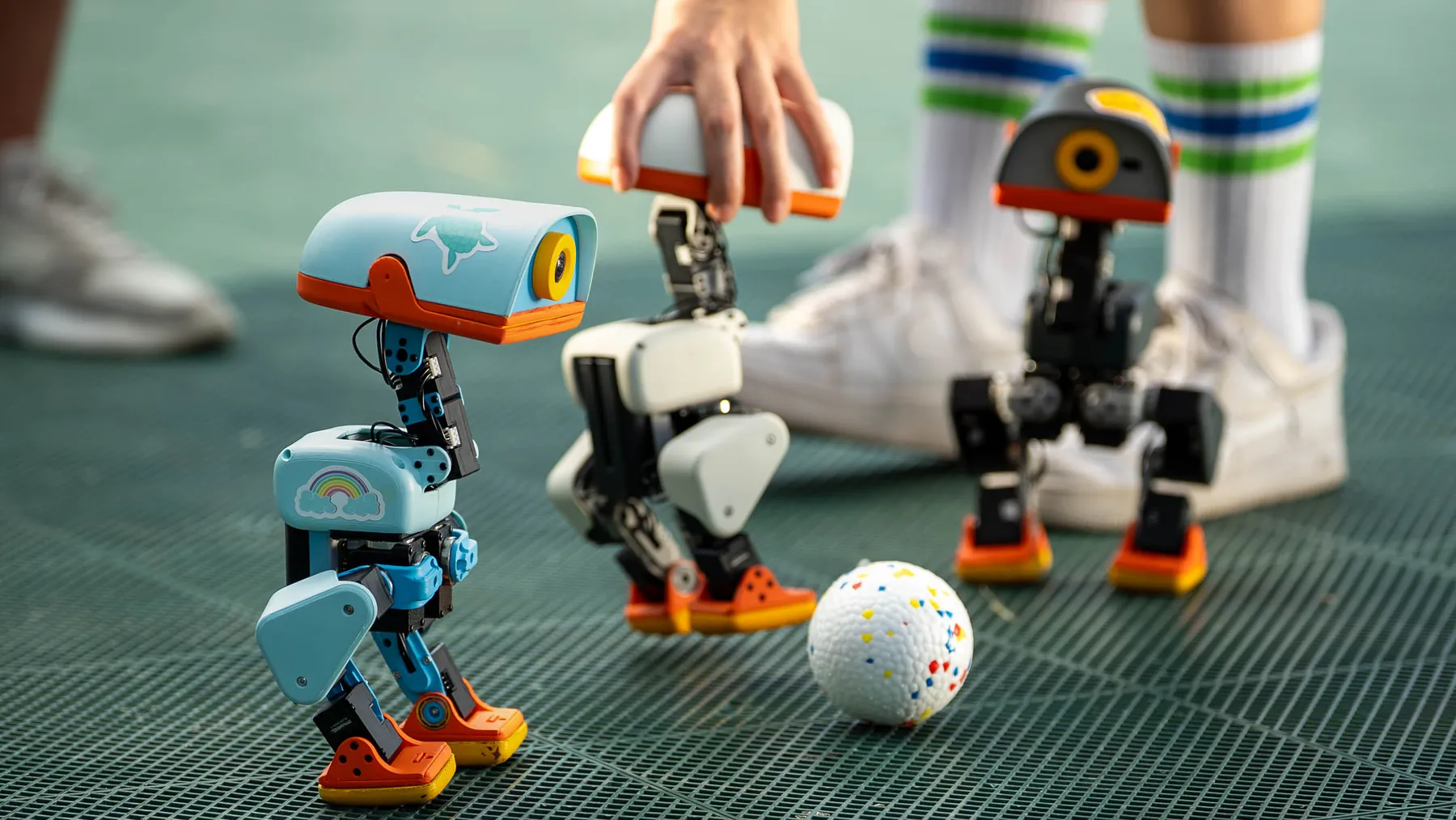
It must be said that Microduck has a characteristic that robot manufacturers have long sought: it seems alive, without trying to resemble a human being.
With its rounded head, its large eye, and its small articulated legs, it almost gives the impression of having its own character.
But its appeal is not limited to its appearance.
A small duck hiding genuine robotic technology
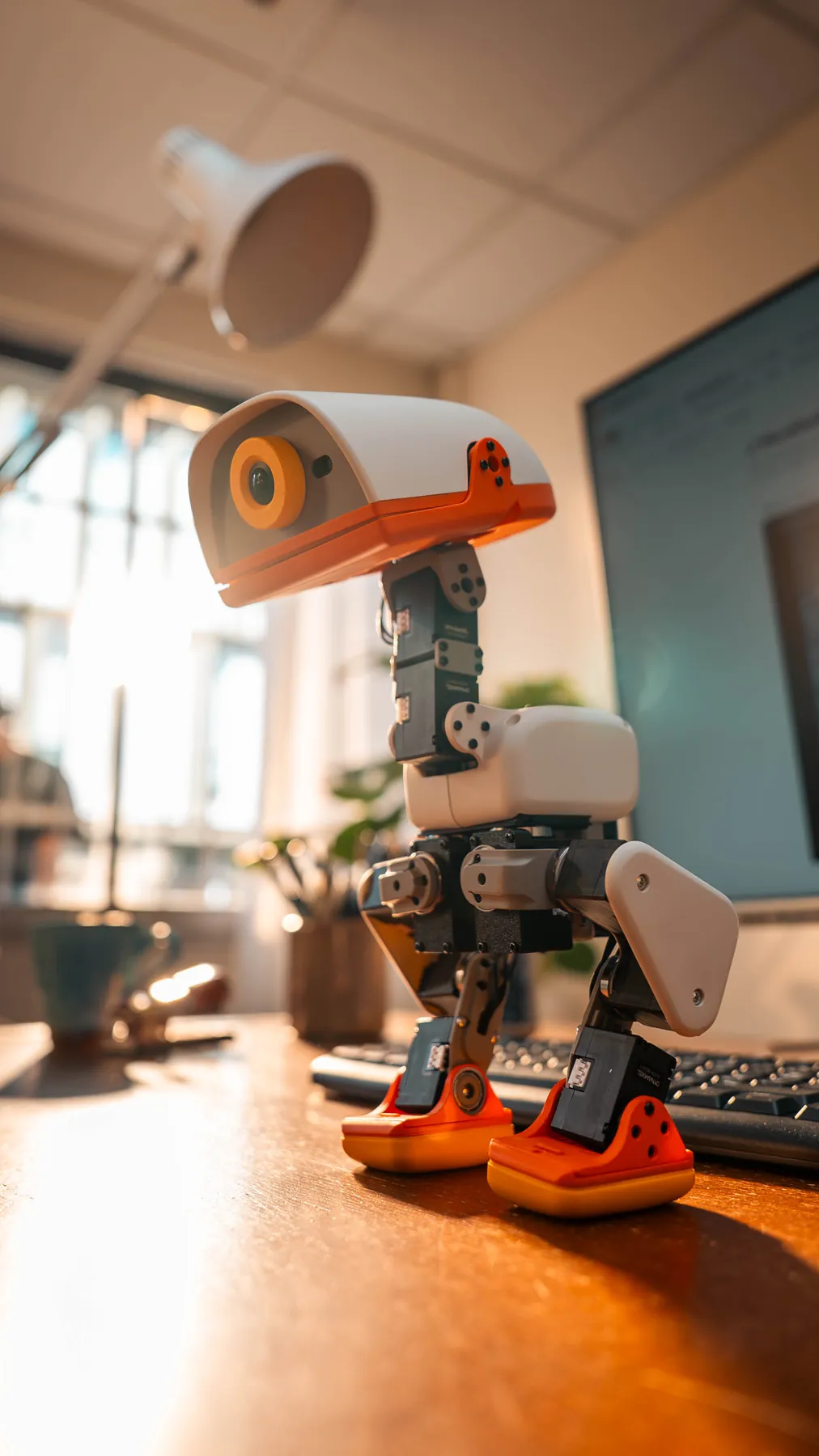
Developed in Bordeaux by Pollen Robotics, a company part of Hugging Face since 2025, Microduck measures 25 centimeters and weighs less than 800 grams.
Its body contains 15 motors that coordinate its movements, posture, and head motions. It also has a camera, a LiDAR-type depth sensor, and two inertial measurement units, used to measure its movements and help maintain its balance.
Its articulated beak even allows it to grab small objects.
More surprisingly, the manufacturer announces that it can walk, crouch, sit down, use small roller skates, and stand back up after certain falls.
These capabilities are not based solely on a series of manually programmed movements.
Microduck notably uses behaviors developed through reinforcement learning, an artificial intelligence method in which a system gradually learns to perform an action by receiving virtual rewards when it succeeds.
Training first takes place in a simulated environment. The learned commands are then transferred to the real machine, a technique called Sim-to-Real.
This is one of the major current research directions in robotics: enabling machines to learn complex behaviors without having to physically perform thousands of trials.
A Christmas toy or a genuine educational tool?
This is probably where Microduck becomes particularly interesting.
Unlike many robotic toys, it is not limited to predefined, closed functions.
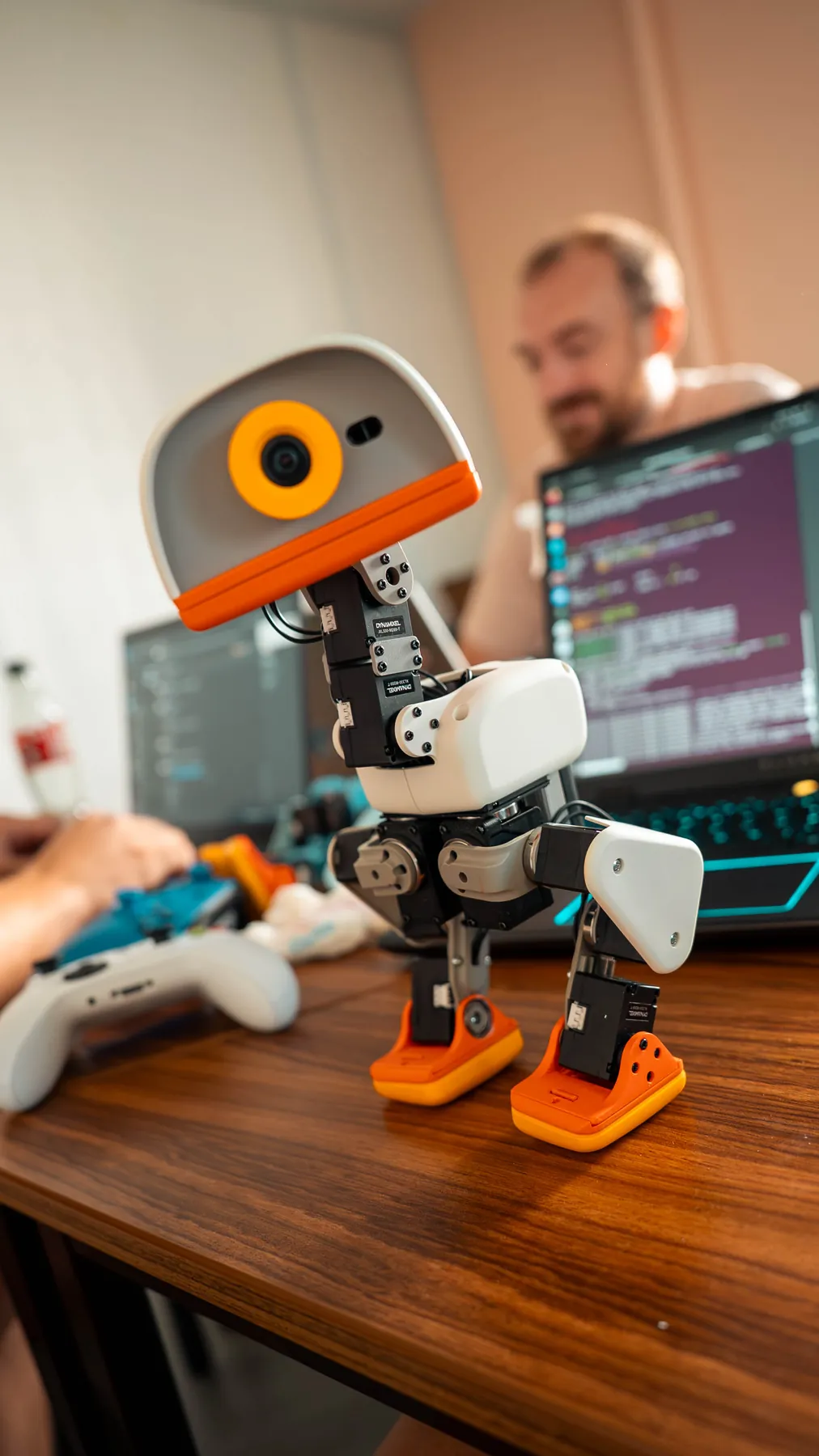
The robot ships with a controller to operate it and several built-in behaviors. It can therefore be used without any prior programming knowledge.
But more experienced users will be able to go much further.
Pollen Robotics offers an open-source software platform for developing new behaviors, running simulation experiments, and working on robotic learning.
A student could experiment with balance algorithms, while a developer could try to modify its gait or teach it new movements.
It should be noted, however, that openness concerns its software: the robot’s mechanical and electronic designs are not presented as open source.
Microduck is also not a conversational assistant comparable to Reachy Mini, the other small robot from Pollen Robotics. It was primarily designed to explore movement and physical interactions.
This distinction is what makes it so original.
Christmas 2026: the ingredients of commercial success?
Microduck has been available for pre-order since August 27, 2026, at the announced launch price of 399 dollars excluding taxes and shipping fees. Pollen Robotics’ European store also lists a price of 340 euros, with any fees specified at checkout.
Four colors are available: cream, graphite, lavender, and sky blue.
The press kit mentioned a goal of first deliveries before Christmas 2026. But as of October 25, the official store states that new orders no longer come with a Christmas delivery promise: it now displays an estimate of 4 to 6 months, in order of purchase. This timeframe remains provisional.
A few limitations should also be considered. Its advertised battery life is about one hour depending on usage, and final age recommendations still need to be specified by the manufacturer.
At this price, Microduck is therefore not necessarily aimed at the same audience as a classic robotic toy.
Its main asset may rather be its ability to bring two worlds together: that of endearing technological gadgets and that of genuine scientific experimentation platforms.
NewsRobotique’s view
Microduck illustrates an interesting evolution in robotics: the technologies used to train industrial machines or humanoids are starting to become available in much smaller devices.
Its friendly appearance may attract the curious, but its ability to serve as a learning tool is what could give it lasting appeal.
It remains to be seen whether its media success will translate into satisfaction among its first users.
Because the difference is considerable between a robot that entertains for a few minutes and a machine one enjoys using, programming, and evolving over several years.
So, will Microduck be the trendy Christmas gift of 2026?
It has several arguments going for it. But its true success may be measured after the holidays, when its owners begin teaching it their own movements.
Readers’ voices
And you, Microduck under the tree?
Choose the answer that suits you best. Results will appear after your vote.
Open, humorous consultation, not representative. Participation does not guarantee one person per vote.
Sources and methodology
The specifications and timeframes come from the manufacturer. The 20,000 pre-orders are a statement by Clément Delangue reported by TechCrunch, without independent audit. This article analyzes announcements and documentation; it is not a review of the robot.