Plastic pollution, overfishing, resource exploitation, and global warming are weakening the oceans. In response, marine robotics is offering new ways to clean up the water, explore the deep sea, and support the restoration of certain ecosystems. This technological shift is also opening up new career opportunities.
Our oceans and seas are essential to human life. Failing to care for them, just as we care for our forests and mountains, makes no sense for humanity. Yet, sometimes blinded by the lure of profit and the constant search for new resources, we continue to weaken ecosystems on which much of our planet’s balance depends. From microplastics and deep-sea overfishing to oil extraction and the degradation of natural habitats, the harm caused to marine biodiversity is no longer merely an environmental concern but a scientifically documented reality.
The figures reveal the scale of the problem. According to the United Nations Environment Programme (UNEP), between 19 and 23 million tonnes of plastic waste enter aquatic ecosystems each year, from rivers and streams to the oceans. In June 2025, the Food and Agriculture Organization of the United Nations (FAO) reported that 35.5% of assessed marine fish stocks were overfished. These pressures are compounded by ocean acidification, rising water temperatures, and increasingly frequent coral-bleaching events. All these phenomena are placing further strain on species already confronted with the destruction or alteration of their habitats.
Yet the picture is not entirely bleak. Around the world, initiatives are helping to protect marine environments and, under certain conditions, encourage biodiversity to return. Marine reserves that are effectively protected show, in particular, that fish populations can recover when human pressures are reduced sufficiently. Protection, however, no longer relies solely on regulation and traditional human intervention. For several years, a new generation of machines has gradually been joining this collective effort: marine robots.
Clean-up robots for seas and oceans
Marine robotics is already present in ports, coastal areas, and some underwater environments. Its role is not simply to make human operations easier, but also to work in places that are difficult to access, sometimes dangerous, or too costly to monitor continuously. One of its most visible applications is the collection of floating waste, which is particularly abundant in port areas where currents can concentrate plastics, packaging, and residues from human activity.
In France, the company IADYS has developed the Jellyfishbot, a small electric surface robot designed to collect waste in ports, marinas, and other bodies of water. With a range of collection systems, the machine can retrieve floating rubbish, certain small plastic fragments, and, when fitted with suitable equipment, pollutants present on the surface. Remotely operated or able to carry out some missions autonomously, the Jellyfishbot illustrates a pragmatic approach to clean-up: intervening regularly and as close as possible to pollution sources before waste disperses further through the marine environment.
But not all waste remains on the surface. Some of it sinks to the seabed and accumulates in places where recovery becomes particularly complex. To address this problem, the European SeaClear2.0 project is developing a system that combines aerial drones, surface robots, and underwater vehicles equipped with cameras, sonar, and gripping devices. Artificial intelligence helps identify objects on the seabed and distinguish certain items of waste from natural features. In Marseille in September 2025, a programme demonstration recovered tyres and other submerged objects. Operations such as these show the technology’s potential, even though large-scale robotic clean-up remains a technical and economic challenge.
Visible waste collection must, however, be distinguished from microplastic pollution. Some robots can collect small floating particles, but microplastics dispersed throughout the water column are far more difficult to remove. No robotic system can currently filter all the world’s oceans effectively. Preventing waste from entering the water therefore remains essential, despite the progress of these technologies.
Explore the guide to drones and exploration robotics
Exploring the depths to understand marine biodiversity better
Protecting the oceans begins with an accurate understanding of what lies within them. Yet much of the seabed is still not mapped at high resolution. Scientists now have tools capable of exploring areas several thousand metres deep, where pressure, darkness, and communication difficulties make human intervention especially demanding.
This is the role, in particular, of autonomous underwater vehicles, or AUVs, and remotely operated vehicles, or ROVs. AUVs can carry out programmed missions using their sensors and navigation systems. ROVs generally remain connected to a vessel by a cable used both to control them and transmit information. These two families of machines complement one another: they are used to map underwater terrain, observe species, study habitats, and inspect submerged infrastructure.
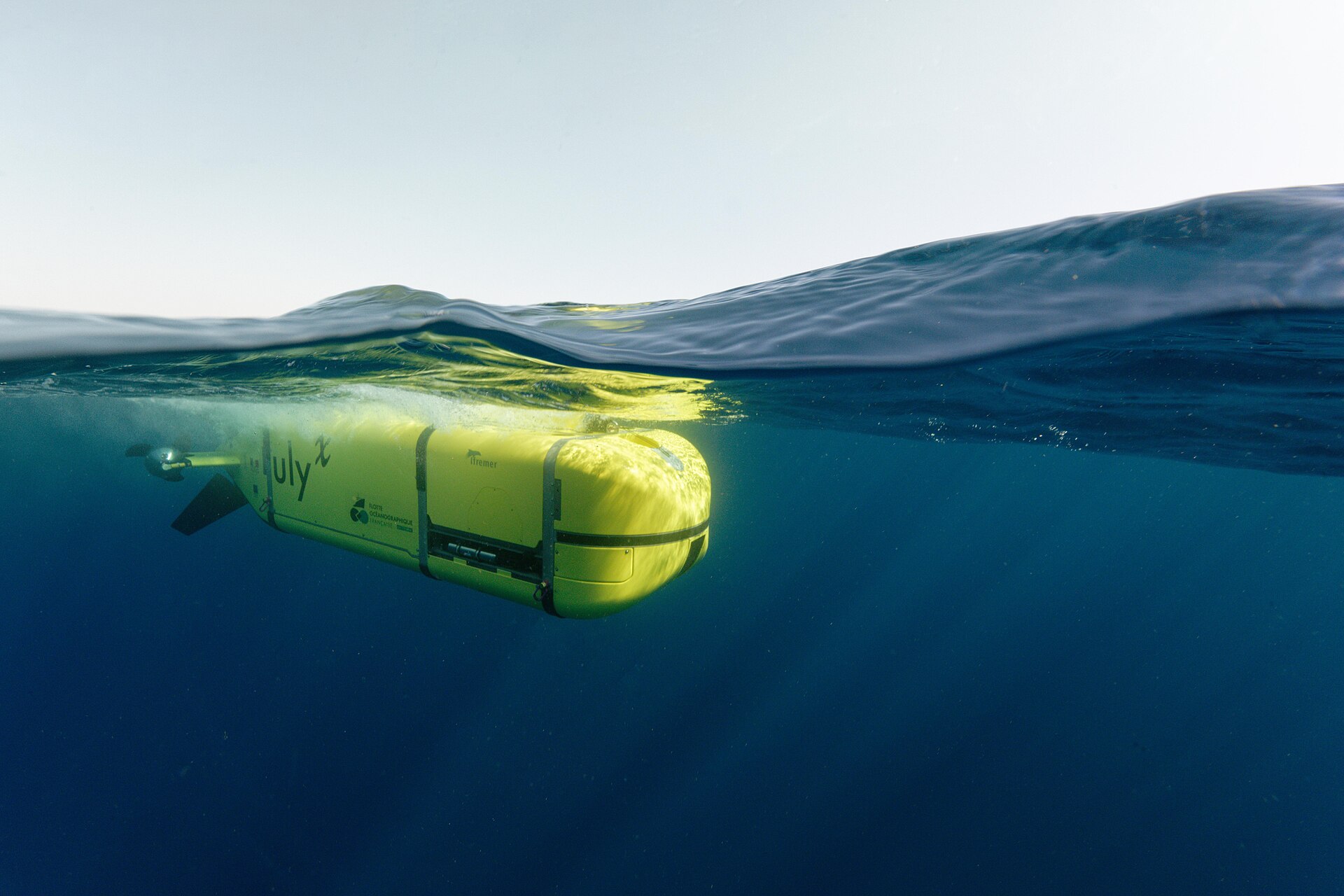
In France, Ifremer operates Ulyx, an autonomous underwater robot designed for deep-sea scientific missions at depths of up to 6,000 metres. Equipped with measuring instruments and imaging systems, it enables researchers to study environments that are difficult to reach by conventional means. The precision of these missions depends on complex technologies that combine sonar, inertial navigation, depth sensors, onboard computing, and data processing. Unlike an aerial drone, a submerged robot cannot rely directly on GPS signals to determine its position. It must reconstruct its movement using several instruments while also accounting for ocean currents.
These capabilities are gradually changing how the oceans are studied. Researchers can repeat certain observations more often, compare how the seabed changes over time, and detect environmental shifts more quickly. Scientific robotics is thus becoming an important tool for documenting biodiversity, monitoring sensitive habitats, and guiding protection policies.
Robotics in support of marine ecosystem restoration
One of the most compelling developments in marine robotics concerns ecological restoration. The aim is no longer simply to measure degradation or remove waste, but to contribute directly to rebuilding certain habitats. Coral reefs are one of the main testing grounds for this approach. Their vulnerability to global warming, pollution, and human disturbance is prompting researchers to develop methods capable of supporting their regeneration.
In Australia, scientists from Queensland University of Technology and Southern Cross University have tested LarvalBot, a semi-autonomous underwater robot used to disperse coral larvae across degraded reef areas. The goal is to encourage settlement and support the corals’ natural renewal processes. Other programmes combine artificial intelligence, mapping, and robotics to identify the areas best suited to restoration work. The Australian Institute of Marine Science (AIMS), for example, uses autonomous platforms including ReefCat to collect images and information about reef health.
These initiatives are promising, but they do not yet offer a universal solution. Releasing larvae or installing young corals does not guarantee that a reef will recover in the long term. The organisms’ survival depends on many factors, including water temperature, environmental quality, biological interactions, and the intensity of human pressures. Robotics can make restoration operations easier and more precise, but it cannot replace the measures needed to limit climate change and habitat destruction.
A technology seeking its place between the economy and the environment
The oceans also play an essential role in the global economy. Maritime transport, fishing, offshore energy, subsea telecommunications, and scientific research all require increasingly sophisticated infrastructure and operations. Marine robotics already makes it possible to conduct certain inspections, reduce dangerous human interventions, and improve data collection. It may also reduce the number of specialist-vessel journeys required for some missions, although the environmental benefits must be assessed case by case.
It would be misleading, however, to portray every marine robot as an ecological tool. The same technologies used to observe and protect the seabed can also be deployed to prospect for new deposits, inspect oil facilities, or prepare extraction activities. A robot is not environmentally friendly merely by existing. Everything depends on its mission, its energy footprint, how it operates, and the consequences of the operations in which it takes part.
The real challenge is to use technological advances to reconcile economic activity more effectively with the preservation of natural environments. Robots can provide reliable data, reduce certain risks, and make previously impossible interventions feasible. But their environmental effectiveness must be judged by concrete results: the amount of waste removed, habitats preserved, pollution prevented, or lasting improvements in ecosystem health.
Working in marine robotics: careers accessible through several routes
Behind these innovations, an entire professional sector is developing around skills in mechanics, electronics, computing, automation, and marine science. Underwater robotics engineers design machines and their navigation systems, while developers work on artificial intelligence, image recognition, and embedded software. Technicians assemble, test, and maintain the equipment. Alongside them, hydrographers, oceanographers, and marine biologists use the data collected to understand the environments under study and prepare interventions.
Young people interested in the field can choose from several educational routes. In France, a technical vocational baccalaureate, a BTS or a BUT qualification in electronics, maintenance, industrial computing, or physical measurement can provide an initial pathway into technical roles. Engineering schools and universities then offer opportunities to specialise in autonomous systems, robotics, and marine science. In Brest, the University of Western Brittany offers specialist training in the maintenance of underwater drones and remotely operated vehicles. ENSTA and IMT Atlantique are also options for students drawn to robotics, automation, and embedded systems.
Career opportunities can be found in scientific research, the maritime industry, defence, offshore energy, and companies specialising in environmental work. In France, Exail, IADYS, and Subsea Tech are among the companies active in the sector. Ifremer laboratories and partner research institutions also offer opportunities for scientific and technical profiles. The field remains specialised, but it calls on skills that can be transferred to other branches of robotics and industry.
For those seeking to combine a passion for technology with environmental protection, marine robotics therefore offers a particularly compelling career path. It provides the opportunity to work on complex machines while contributing, depending on the project, to our knowledge and preservation of the oceans.
Protecting the oceans goes far beyond technology
Marine robots will not save the oceans on their own. They cannot replace political decisions, industrial commitments, or the collective efforts needed to reduce pollution and preserve natural resources. They are, however, valuable instruments within a broader strategy, enabling us to understand still little-known environments more clearly and intervene in conditions that are sometimes impossible for humans.
The future of marine robotics will therefore not be measured solely by the depth a machine can reach, the sophistication of its artificial intelligence, or the number of hours it can remain underwater. It will also depend on what these technologies genuinely make it possible to preserve, restore, or manage more effectively. Beyond technical performance, true progress lies not only in creating robots capable of exploring the oceans, but in learning to use them so that marine life can continue to thrive there.
NewsRobotique — October 2026
Scientific sources and resources
Environment and research: United Nations Environment Programme (UNEP), Food and Agriculture Organization of the United Nations (FAO, 2025 global marine fish stock assessment), Ifremer, and the Australian Institute of Marine Science.
Robotics technologies: IADYS — Jellyfishbot, SeaClear2.0, and the French Oceanographic Fleet.
Training and careers: University of Western Brittany, ENSTA, IMT Atlantique, Exail — Careers, and Subsea Tech.