Long confined to research laboratories and the most prestigious operating theatres, medical robots are now entering hospital corridors, rehabilitation centres and even some medical practices. Their mission is to assist healthcare professionals, make technical procedures safer and improve patient care. Behind these advances, however, lies an essential question: at what cost, and with what tangible benefits?
Imagine a hospital where one robot brings medicines to nurses, another supports a paralysed patient through rehabilitation and a third helps a surgeon remove a hard-to-reach tumour. The scene might sound like science fiction. Yet these technologies already exist, and some are used every day in French healthcare facilities.
The transformation is well under way. In October 2025, France’s National Academy of Medicine counted more than 300 surgical robots in the country’s public and private healthcare facilities. A nationwide study published on 17 October 2026 confirms the technology’s growth while also highlighting major differences between medical specialties and regions.
One misunderstanding must nevertheless be cleared up: most medical robots do not treat patients by themselves. They carry out movements controlled by a professional, support a decision or perform specific tasks under human supervision. Full autonomy, particularly in surgery, remains largely a research topic.
From surgery to rehabilitation, robots are already among us
The best-known representative of medical robotics remains the Da Vinci system developed by US company Intuitive Surgical. Its articulated arms, three-dimensional vision and miniaturised instruments enable a surgeon to perform complex procedures from a control console. It is particularly common in urology, but is also used in digestive, gynaecological and thoracic surgery.
At the end of 2025, Intuitive reported that approximately 11,106 Da Vinci systems had been installed worldwide and that more than 3.15 million procedures had been performed during the year. In France, the Montpellier Cancer Institute has adopted the Da Vinci 5, a new generation that provides force feedback so the surgeon can better assess the forces exerted by the instruments.
Competition is organising itself around this US giant. British company CMR Surgical develops Versius Plus, a modular system whose separate arms can be positioned around the patient. US company Medtronic, with its Hugo robot, is likewise seeking to broaden access to robot-assisted surgery. Both platforms reached new regulatory milestones in the United States between December 2025 and October 2026.
Robotics is also used in orthopaedic procedures. Stryker’s Mako system assists surgeons with knee or hip replacement by combining anatomical planning with precise instrument guidance. Here again, the robot does not decide how to perform the operation; it helps the practitioner follow the planned trajectory.
France also has some particularly innovative companies. Montpellier-based Quantum Surgical designed Epione, a robot that helps interventional radiologists position a needle accurately to destroy certain tumours using heat or cold, without open surgery. Toulouse University Hospital adopted it in 2025, and Nîmes University Hospital was also using it in 2026. This type of procedure could expand treatment options for some patients whose lesions are difficult to reach.
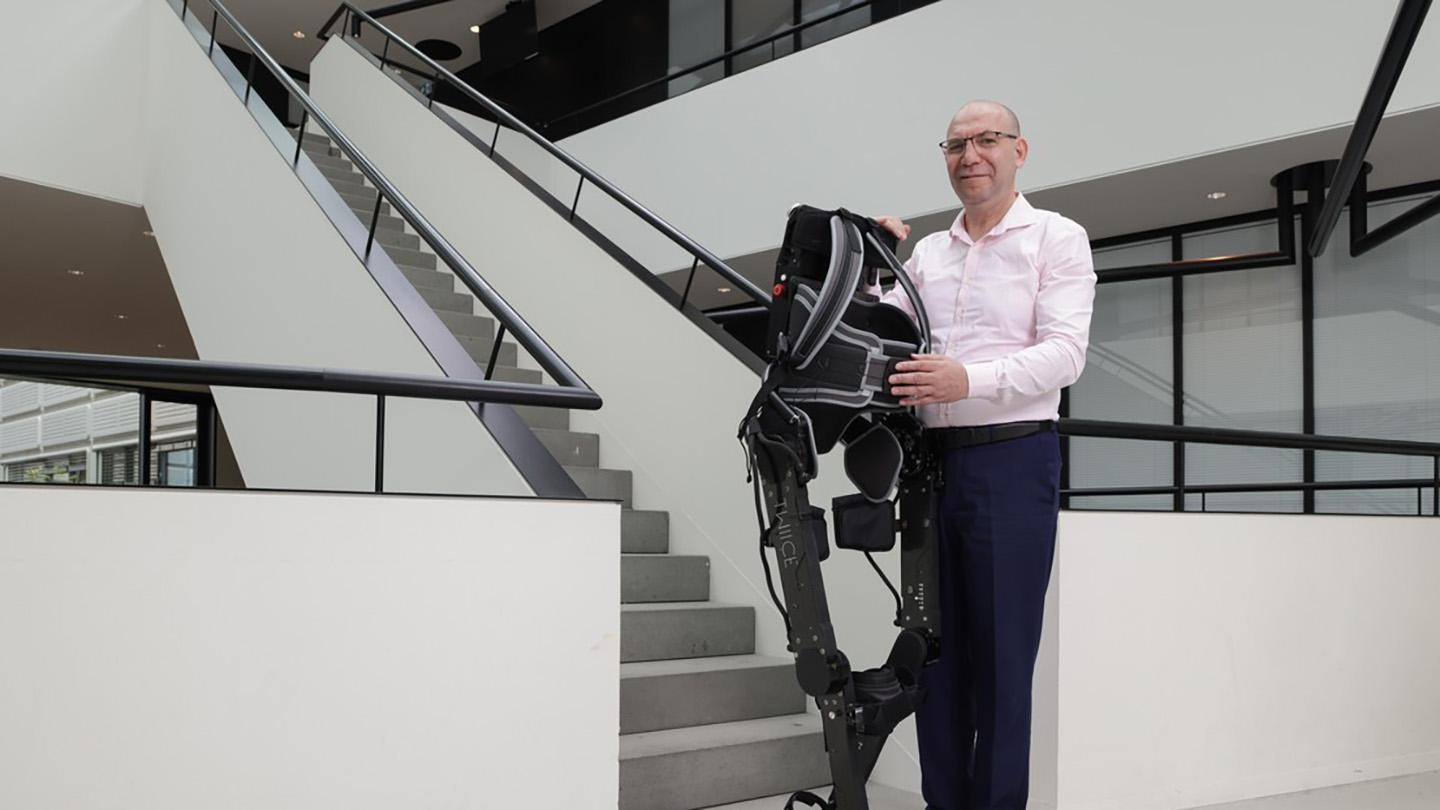
Rehabilitation is another particularly promising field. French company Wandercraft develops Atalante X, a self-balancing exoskeleton that enables patients with severe walking impairments to stand and exercise under professional supervision. According to the company, its technology is present in more than 150 clinical and research centres worldwide. Swiss company Hocoma, with Lokomat, is another specialist in robotic gait rehabilitation.
This does not mean that a paralysed patient will automatically regain independence. These machines primarily provide new ways to train, mobilise the body and measure progress. Their effectiveness depends on the condition, the patient’s health and the rehabilitation protocol.
Explore the guide to medical robotics
Robots for medicines, examinations and everyday hospital tasks
The robotic transformation is not limited to spectacular procedures. It may prove even more visible in hospital corridors and pharmacies.
In the United States, Moxi, a mobile robot from Diligent Robotics, transports supplies and medicines between departments. Equipped with an articulated arm, sensors and autonomous navigation capabilities, it can move through a busy hospital environment. In August 2026, its manufacturer announced the rollout of Moxi 2.0, a new generation built on several years of experience in more than 25 US hospitals. Other companies, such as Aethon with its TUG range, develop solutions specialised in internal deliveries.
The aim is not to replace nurses with machines, but to reduce the time they spend on repetitive journeys. That benefit is real only if the robot is reliable, fast and properly integrated into the hospital’s organisation.
Hospital pharmacies are another favourable setting. Systems offered by BD Rowa, Omnicell and Swisslog Healthcare can automate medicine storage, logistics preparation and distribution. In France, Lille University Hospital announced in 2026 that it was deploying automated systems capable of preparing around 4,500 doses per week across several care units. Pharmacists remain responsible for validating treatments and ensuring their safety.
In some facilities, robots fitted with ultraviolet lamps also supplement disinfection work. Danish company Blue Ocean Robotics, through UVD Robots, is one of the specialists in this technology. UV-C radiation can reduce contamination on some surfaces, but these systems replace neither conventional cleaning nor hygiene protocols. The available studies do not consistently demonstrate a reduction in hospital-acquired infections.
Medical practices could also benefit from these innovations. French company AdEchoTech markets MELODY, a system that allows a physician to control a robotic ultrasound probe remotely. A professional beside the patient handles setup and monitors the examination. This can be particularly valuable in areas where specialists are scarce.
In the United States, Neocis offers Yomi, a robotic platform that assists with dental implant placement. The practitioner retains control of the procedure while the system helps them follow the planned position. The technology is already marketed in the US, but its international distribution remains limited.
How much do medical robots cost?
It may be the least spectacular question, but it is one of the most important. Every robot brings purchasing, maintenance, training and IT integration costs, and sometimes requires proprietary consumables.
According to its 2025 annual report, Intuitive sells Da Vinci systems for prices generally ranging from $700,000 to $3.1 million, depending on the model, configuration and market. Annual maintenance contracts usually cost between $95,000 and $225,000. Instruments and accessories add a further $900 to $3,700 in revenue for the manufacturer per procedure.
Hospital pharmacy automation is not necessarily much more affordable. In Troyes, two robots installed for centralised medicine dispensing cost more than €420,000 each, according to a report published in October 2024.
Prices for mobile logistics robots, exoskeletons, remote-ultrasound systems and disinfection equipment are usually provided on request. They depend on the equipment, the number of units, the software, related services and the selected business model.
These costs raise a difficult question: do the resulting savings genuinely offset the investment? A 2026 systematic review of randomised trials of robot-assisted surgery found it to be more expensive in 33 of the 36 trials that allowed this comparison. That result does not mean robotics is useless, but it does show that its value must be assessed procedure by procedure.
The pioneering companies and the next developments
The United States has a major position in this sector through Intuitive Surgical, Medtronic, Stryker, Diligent Robotics and Neocis. The United Kingdom has an important player in CMR Surgical, while Switzerland stands out in rehabilitation through Hocoma. Denmark has positioned itself in robotic disinfection through Blue Ocean Robotics.
France nevertheless has genuine industrial expertise, notably through Quantum Surgical in interventional radiology, Wandercraft in exoskeletons and AdEchoTech in remote ultrasound. These companies show that medical innovation is not simply about building ever-larger surgical robots. It also involves inventing new, sometimes more focused applications that could be accessible to a wider range of facilities.
Several developments will deserve particular attention in the coming years: robots capable of providing better assistance during procedures, mobile equipment taking on more logistics tasks, more personalised rehabilitation systems and teleoperation solutions that allow a specialist to intervene remotely.
Artificial intelligence could improve environmental perception, motion planning and medical-data analysis. A machine capable of identifying a situation, however, does not necessarily have the autonomy or regulatory authorisation to make a treatment decision. Cybersecurity, medical responsibility and data protection will remain essential as these systems become more connected.
A medical revolution, provided it benefits patients
The arrival of robots in hospitals is unquestionably a technological advance. Measuring their success only through their mechanical precision or sophistication, however, would be a mistake. A robot can be impressive without providing any additional clinical benefit over a conventional method.
The real issue is therefore not how many robots tomorrow’s hospitals will own, but what services those robots can genuinely provide. Reducing certain complications, supporting recovery, improving access to specialists, easing the burden on healthcare teams and guaranteeing greater safety are all goals that fully justify research and investment.
One major difficulty remains: equal access. If only the best-funded facilities can benefit from the most advanced technologies, robotics may deepen disparities instead of reducing them.
NewsRobotique’s analysis: tomorrow’s medical robot will probably not be a humanoid replacing the doctor. It will more often be a specialist assistant, sometimes almost invisible to the patient, but capable of reliably carrying out tasks that make healthcare professionals’ work easier. Its true success will be measured less by the number of machines installed than by the time returned to healthcare workers and the tangible improvements delivered to patients.
Main documentary sources
- French National Academy of Medicine — Robotic surgery and equal access, October 2025
- Journal of Robotic Surgery — French nationwide study, October 2026
- Intuitive Surgical — 2025 annual report
- FDA — Computer-assisted surgical systems
- Nîmes University Hospital — Epione robot, June 2026
- Wandercraft — Clinical documentation
- Diligent Robotics — Moxi 2.0, August 2026
- AdEchoTech — MELODY remote-ultrasound system
- NICE — Assessment of robot-assisted surgery systems