History of medical and healthcare robotics
From the first surgical arms to therapeutic microrobots
Robots help guide instruments, repeat exercises, transport equipment or support interaction. This history connects machines to the needs of patients and teams, while distinguishing research, trials, commercialization and regulatory decisions.
A medical robot does not become a doctor: its use is part of human care and human responsibility.
Documentation: October 12, 2026 · Educational selection, not exhaustive · Each date refers to the milestone described.

1983–1991 · The first assistants
Positioning, guiding and transporting: the first robots address well-defined tasks.
Arthrobot
Brian Day, James McEwen and Geof Auchinleck
Canada
A voice-controlled assistant helps position a limb during an orthopedic procedure.
How it works and historical significance
Robotics begins here with mechanical assistance to the team, not with an autonomous surgeon. Historical accounts diverge: Auchinleck's testimony places the idea in 1983, the construction in 1984 and a first procedure on March 12, 1985. The date range avoids presenting 1983 as an undisputed clinical date.
PUMA 200
Yik San Kwoh’s team · Unimation arm
United States
An industrial arm is adapted to position a guide for a brain biopsy under CT control.
How it works and historical significance
The precision depends on the alignment between the images, the patient and the robot. The pioneering work is associated with 1985; the original 1988 publication documents the improvement of the positioning. The robot does not perform a complete brain operation on its own.
PROBOT
Brian Davies and team · Imperial College / Guy’s Hospital
United Kingdom
PROBOT performs the resection of prostatic tissue inside a volume defined by the surgeon.
How it works and historical significance
The clinical milestone described by Imperial College is April 1991. It must be distinguished from research from the late 1980s. The automation concerns a bounded task, with medical preparation and responsibility; it does not mean general autonomy.
HelpMate
Transitions Research Corporation
United States
A mobile robot transports objects through hospital corridors.
How it works and historical significance
Navigation combines a representation of the environment and sensors to avoid obstacles. The 1989 publication is the documentary reference retained: on its own, it does not set a universal date of commercialization. Logistics frees up time without performing a medical act.
1991–1994 · Measuring and preparing
Bone planning and rehabilitation open up new applications.
MIT-MANUS
Neville Hogan, Hermano Krebs and colleagues · MIT
United States
An interactive device accompanies arm movements and measures effort for rehabilitation.
How it works and historical significance
MIT-MANUS is documented as early as 1991. In March 1994, MIT describes trials planned for the autumn. Measurement and assistance make it possible to study reproducible exercises; relevance depends on the patient's situation and the therapeutic program.
ROBODOC
Integrated Surgical Systems · work with IBM
United States
ROBODOC prepares the femur for the placement of a hip prosthesis, according to a plan derived from imaging.
How it works and historical significance
The Smithsonian archives describe the authorization of a limited human study in Sacramento in 1992–1993. This was a trial milestone, to be distinguished from a general commercial authorization. Bone milling is a specialized task, prepared and supervised.
IRCAD
Jacques Marescaux and his team
France · Strasbourg
IRCAD develops an environment for research, training and exchange in minimally invasive surgery.
How it works and historical significance
Its thirtieth anniversary in 2024 places its creation in 1994. The contribution is not limited to a machine: training teams, sharing practices and conducting experimental work accompanies the evolution of techniques.
1999–2005 · Consoles and companions
Remote surgery, guided walking and sensory assistance: several avenues are developing.
da Vinci
Intuitive Surgical
United States
The surgeon controls articulated instruments from a console, with visualization of the operating field.
How it works and historical significance
Intuitive's report places the first sales outside the United States in the second quarter of 1999. The FDA issued a 510(k) decision on July 11, 2000 for specific uses. Indications subsequently evolved: this decision does not amount to authorization for all procedures, nor to French authorization.
Operation Lindbergh
Jacques Marescaux and team · IRCAD · ZEUS system
France / United States
On September 7, 2001, a team in New York operated on a patient in Strasbourg to remove her gallbladder.
How it works and historical significance
The procedure used ZEUS, not da Vinci. The transmission of commands demonstrated the crucial role of latency, the reliability of communications, and the team present with the patient. This historic success does not mean that transatlantic telesurgery became a routine practice.
Lokomat
Hocoma · collaboration with Balgrist
Switzerland
A motorized orthosis guides the legs on a treadmill with body-weight support.
How it works and historical significance
The manufacturer places the market launch in 2001. The device makes it possible to organize repetitive walking exercises, with therapeutic adjustments and monitoring. Guided training does not guarantee identical recovery for every patient.
PARO
Takanori Shibata · AIST
Japan
This baby seal-shaped robot reacts to touch and other sensory stimuli.
How it works and historical significance
The 2004 announcement precedes the Japanese sales documented from 2005 onward. PARO can serve as a support for accompanied interaction. It is not a living animal and does not replace human relationships or care; its acceptability depends on the person and the context.
2007–2014 · From trajectories to mobility
Neurosurgery, exoskeletons and motorized prostheses cross regulatory milestones.
ROSA Brain
Medtech · Bertin Nahum
France · Montpellier
ROSA supports neurosurgical procedures by linking planning and the positioning of a robotic arm.
How it works and historical significance
Medtech's base document distinguishes the stages of development and certification. The guidance helps the team reach planned trajectories. ROSA Brain should not be confused with the ROSA systems later intended for other specialties, including the knee.
ReWalk
Argo Medical Technologies / ReWalk Robotics
Israel / United States
A motorized exoskeleton assists certain users with a spinal cord injury in standing and walking.
How it works and historical significance
2014 is here an American regulatory step, not the date of invention. User selection, training and conditions of use remain decisive. Mechanical assistance does not repair the spinal cord and is not automatically suitable for all paralyzed people.
DEKA Arm
DEKA Research and Development
United States
A motorized upper-limb prosthesis coordinates several joints to perform functional tasks.
How it works and historical significance
Control systems use signals from the user. The evaluation focuses on the tasks actually accomplished, not just the number of motors. A prosthesis replaces a missing function; an exoskeleton assists an existing limb: their goals and constraints differ.
2019–2022 · Interfaces and small scales
Brain signals and cell manipulation broaden the research.
Clinatec · brain–exoskeleton interface
CEA · CHU Grenoble Alpes · team of Alim-Louis Benabid
France
A tetraplegic participant controls the movements of an exoskeleton using brain signals recorded by implants.
How it works and historical significance
The demonstration published in The Lancet Neurology is an experimental proof of concept. The device was used in a controlled environment with safety support: it does not demonstrate autonomous free walking at home, nor a commercially available solution for everyone.
Microrobots for manipulating cells
ISIR · CNRS / Sorbonne Université
France
Microscopic objects driven by optical tweezers make it possible to manipulate cells.
How it works and historical significance
This research combines manipulation, perception and force feedback. The original article is from September 2022; a republication in 2025 does not constitute a new invention. Cell manipulation in a laboratory is not a treatment performed inside the human body.
2024–2026 · Force feedback and microrobots
Commercialized systems are progressing while others remain experimental.
da Vinci 5
Intuitive Surgical
United States
The fifth generation notably brings force feedback and developments to the control platform.
How it works and historical significance
The manufacturer's announcement describes an American regulatory decision and a gradual initial rollout. The assistance and computing functions do not make the system an autonomous surgeon. A technical improvement must be distinguished from a clinical benefit established for each indication.
Microrobots guided by learning
Daniel Ahmed and team · ETH Zurich
Switzerland
Microrobots trained through learning are steered by ultrasound through channels that replicate vascular networks.
How it works and historical significance
The June 2025 study combines simulation and microfluidic experiments. Laboratory channels are not the vessels of a treated patient. The work explores navigation; it does not demonstrate an authorized autonomous human therapy.
Therapeutic magnetic capsules
Bradley Nelson, Salvador Pané and teams · ETH Zurich
Switzerland
Capsules containing magnetic particles are guided and studied to deliver substances locally.
How it works and historical significance
The November 2025 announcement describes vascular models and trials in large animals. The January 2026 presentation outlines research perspectives. Despite their potential, this work is not proof of routine clinical use in humans; safety, elimination and evaluation remain essential.
Six families, six healthcare needs
Surgery
From trajectory guides to consoles, the robot transmits, stabilizes or executes a planned task. PUMA, ROBODOC, PROBOT, da Vinci and ROSA illustrate different modes of control. The team chooses the indications, verifies the system and manages complications.
Rehabilitation
MIT-MANUS and Lokomat make it possible to measure and repeat movements with adjustable assistance. Repetition alone is not a guarantee of effectiveness: exercises, the patient’s effort and the therapist’s follow-up remain essential. The home adds safety and supervision constraints.
Prosthetics and exoskeletons
The DEKA Arm replaces functions of the upper limb; ReWalk assists the mobility of an equipped user. Fitting, training, energy, cost and selection determine use. A cerebral proof of concept like Clinatec remains distinct from a product for daily life.
Hospital robotics
HelpMate demonstrates the value of autonomous logistics: transporting supplies and moving through corridors. The robot must coexist with patients and professionals. Reliability, access to areas and the organization of flows determine the real gain.
Assistance and companionship
PARO serves as a sensory and relational mediator. The person must be able to accept or refuse the interaction. Robots do not replace a human presence and must not raise undemonstrated therapeutic expectations.
Medical microrobotics
Manipulating cells, navigating channels or guiding capsules opens up promising research. In vitro and animal results are not available human care. Biocompatibility, control, localization and elimination must be evaluated.
France: research, training and precision
In Strasbourg, IRCAD has connected research and training since 1994; the 2001 Operation Lindbergh illustrates a major contribution to telesurgery. In Montpellier, Medtech developed ROSA Brain starting in 2007, before the CE and FDA milestones.
In Grenoble, Clinatec brings together hospital teams and the CEA around brain–machine interfaces. In Paris, research at ISIR, CNRS and Sorbonne Université explores cell manipulation. These examples cover different levels of maturity and do not form a ranking of institutions.
Outlook: moving forward without confusing promise with care
AI and human control
AI can contribute to perception, image analysis or planning. Autonomy in navigation or positioning does not mean autonomy in medical decision-making. The force feedback of da Vinci 5 and the learning of microrobots serve different functions.
Hospital, home and support
Logistical assistance and home exercises can broaden uses. Their value must be established in the real context: supervision, maintenance, accessibility, acceptability and the protection of people matter as much as the technical demonstration.
Safety, data and regulation
Medical devices intended for the European market fall under an evaluation and surveillance framework, notably Regulation 2017/745. An FDA decision concerns the United States and specific uses; it is not equivalent to a universal authorization.
Cybersecurity must be monitored throughout the life cycle: access, updates, communications and continuity of use. Patient data, consent and responsibility must be examined with the relevant teams. An industry announcement alone does not prove a superior clinical benefit.
Sources and references
Priority to original publications, public bodies, laboratories and contemporary documents. Manufacturers document their own announcements and histories; their statements do not constitute an independent clinical evaluation. For Arthrobot, the accounts diverge: the date range and the nature of the testimony are made explicit.
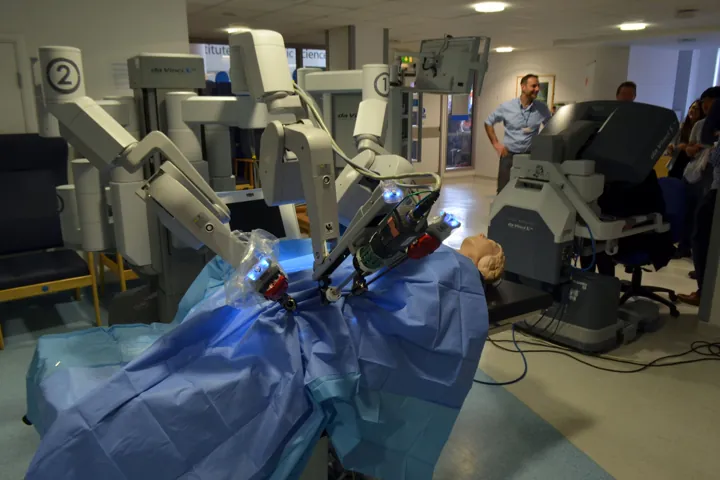
The introductory photograph is authentic, credited and reusable under CC BY-SA; it shows a system in 2015, not the model 5. The illustrated historical documents remain accessible via the cards’ links where their reuse is not established. No generated image is presented as an archive.
- Arthrobot — testimony of Geof Auchinleck
- Kwoh et al., 1988 — positioning for stereotactic surgery
- Imperial College — PROBOT program
- Imperial College — Brian Davies and the 1991 clinical milestone
- HelpMate, 1989 publication
- Smithsonian — ROBODOC archives
- MIT — MIT-MANUS and the trials planned in 1994
- Krebs et al. — robot-assisted rehabilitation and MIT-MANUS history
- Intuitive — historical report, commercialization in 1999
- FDA — da Vinci, decision of July 11, 2000
- IRCAD — Operation Lindbergh, September 7, 2001
- IRCAD — thirtieth anniversary in 2024
- Hocoma — Lokomat User Script, history and operation
- PARO — 2004 commercialization announcement
- PARO — sales history since 2005
- Medtech — financial document, ROSA development and certifications
- FDA — ReWalk, De Novo decision of June 26, 2014
- FDA — DEKA Arm prosthesis and functional evaluation
- CEA — Clinatec proof of concept, 2019
- CNRS — cell manipulation by microrobots, 2022
- Intuitive — da Vinci 5 FDA announcement, March 14, 2024
- ETH — microrobots and learning, June 26, 2025
- Medany et al. — peer-reviewed study, 2025
- ETH — guided capsules, preclinical experiments of November 2025
- ETH — presentation of the research in January 2026
- FDA — computer-assisted surgical systems
- ANSM — medical device cybersecurity recommendations
- European Union — Regulation 2017/745 on medical devices
NewsRobotique · FJVR · Editorial method · About · Legal notice · Contact