
At the Mondial de l’Auto 2026, the intelligent car is everywhere. Yet, as you walk the aisles, another impression emerges: the robots that build these vehicles remain almost invisible. This visit offers a glimpse of an industry that now talks as much about data, autonomy, and software as about mechanics — but still tells far too little about those who manufacture the automobiles.
It is with this perspective, that of NewsRobotique, that we explored the Paris show. Not to draw up a catalogue of new products, but to understand what automation is really changing, from the factory to the road. And, above all, to distinguish the technologies that already work from the ambitions still to be realized.
Factories very present in reality, far less so on the stands
The automobile industry is one of the industries that has contributed most to the development of robotics. For decades, articulated arms have been welding body shells, applying paints, handling parts and supporting assembly operations. In the workshops, technicians, automation specialists, engineers and operators evolve these machines every day. Without this organization, the vehicles on display at the show would not exist in their current form.
There was therefore a certain frustration at not encountering more of this industrial dimension during our visit. A real robotic cell in operation, a collaborative robot or a concrete presentation of an assembly station would have connected the finished product to its manufacturing. What is missing is not only the spectacle of the machine: it is also the visibility of the women and men who design, program and maintain it.
The observation deserves to be qualified, however. The space dedicated to the French sector presented industrial innovations, notably at Valeo, FORVIA and Dassault Systèmes. But production appeared there mainly in the form of screens, infographics and digital demonstrations. Robotics had not disappeared; it had simply become less tangible for the visitor.
Valeo: AI leaves the laboratory to support the entire automotive chain
The journey proposed by Valeo summed up this evolution quite well. Visitors discovered artificial intelligence applied to embedded systems, design tools and factory operations. One presentation mentioned the use of AI to accelerate research and development; another displayed the proportion of code produced with AI tools according to the scope defined by the equipment manufacturer.
The figure of 35% photographed on the stand impresses, but it must not be interpreted as a measure of quality or as proof that software design is becoming autonomous. Generated code still requires specifications, testing, validation and, in critical functions, particularly rigorous safety requirements. The interest lies elsewhere: AI is now embedded in the daily work of technical teams and promises to change their methods.
The transformation also affects production. By leveraging measurements from machines, industrial vision and operating histories, analysis systems can help detect defects or anticipate incidents. AI does not replace industrial robotics; it adds an interpretive capability to the machines and processes that make it up.
With Waymo, the car takes on the characteristics of a mobile robot
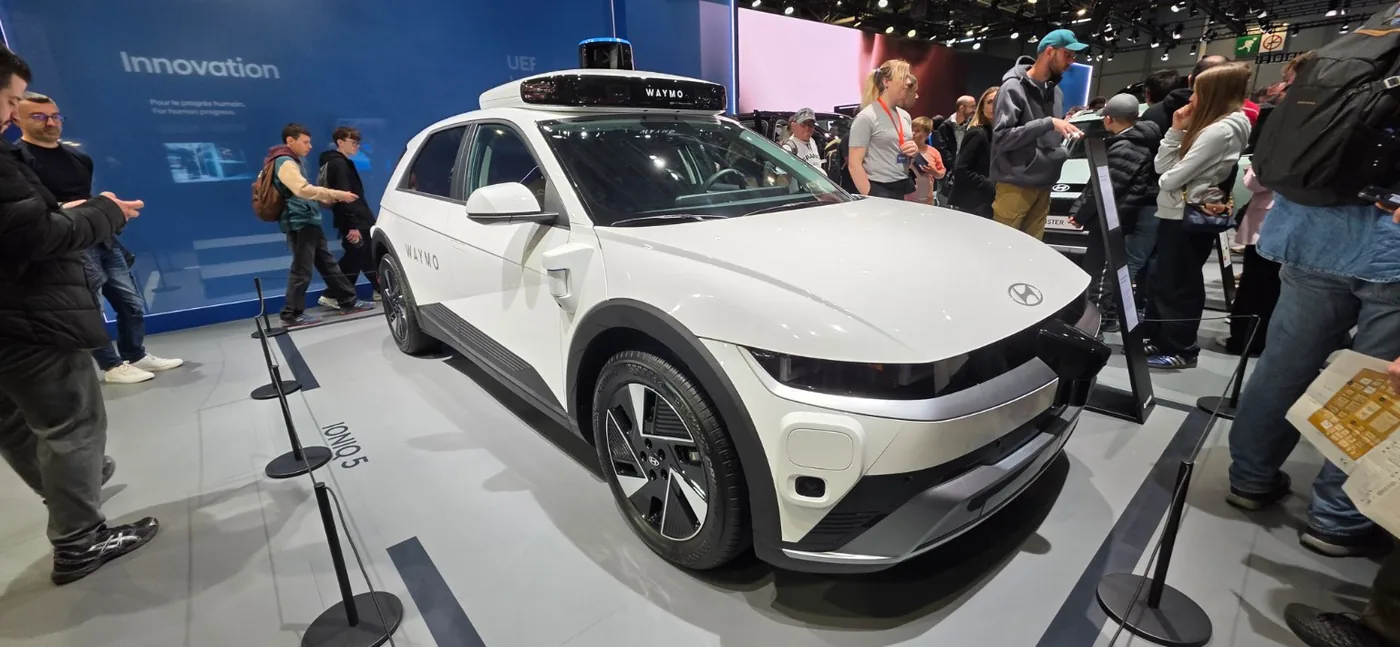
The Hyundai IONIQ 5 equipped with Waymo technology was one of the most striking objects of this visit. At first glance, one recognizes an electric SUV. By observing its roof, its sensors and its perception equipment, one understands that it is also a robotic platform capable of apprehending a complex road environment.
Its operation relies on a succession of operations that recall mobile robotics: perceive the space, localize, recognize other road users, anticipate certain movements, then decide on a trajectory. Cameras, radars and LiDAR contribute to this reading of the environment, while planning software controls the vehicle’s movements. The whole challenge consists of repeating these operations reliably enough, in a context where every situation can be different.
Waymo aims at level 4 automation within defined operating domains. This is not universal autonomy: geographic, operational and environmental conditions matter. This limit is fundamental to avoid putting on the same level a robotaxi operated in a given zone and a car simply equipped with advanced driver assistance.
An experience dedicated to automated driving, but not to level 5
Outside the halls, the “Autonomous Cars Experience” was a particularly useful extension of the static presentations. An educational space explained how a vehicle detects its environment, analyzes situations and reacts. Supervised trials on open roads then allowed visitors to discover certain advanced automated driving systems.
The Mondial notably announced demonstrations by Tesla and XPENG. Tesla provided Model 3 vehicles to present its supervised FSD; XPENG let visitors discover its NGP system. However, this was not a level 5 driving demonstration. The official program mentioned “level 2++”, a commercial and informal expression that remains attached to level 2 of the SAE classification: the vehicle can take charge of steering and speed, but the driver retains an obligation of permanent supervision.
This precision is far from being a detail. The impression of driving performed by the machine can be strong, without the system being authorized to operate without a driver. The Centre d’Essais général, in which BYD notably participated, also offered the discovery of many vehicles; this space should not be confused with the specialized automated driving demonstrations.
The two photographs of this space ultimately say a lot about the value of the show: beyond the speeches, they show an attempt to make the public understand the real capabilities and limits of current systems. It is an essential approach as the vocabulary of autonomy makes its way into automotive communication.
Tesla: between the Cybercab’s promises and Optimus’s silence
At Tesla, the Cybercab immediately caught the eye. Its golden silhouette, its spectacular opening doors and its absence of traditional driving controls stage a mobility designed around driverless transportation. The vehicle expresses a clear ambition: that automobile travel becomes an automated service rather than an activity one must necessarily drive oneself.
But the object on display was not a driving demonstration. The presence of a prototype on a podium says nothing, on its own, about a software’s ability to handle the unexpected, to respect all the rules of the road or to operate in difficult weather conditions. As is often the case in robotics, the difference between a promising architecture and a mature system is measured during testing and real-world operation.
A little further on, the Optimus humanoid robot appeared behind a glass case. Its morphology, its joints and its hands expressed Tesla’s ambitions beyond the automotive sector. That said, on site, no dynamic demonstration allowed visitors to assess its manipulation, movement or autonomy performance. This display choice almost illustrated our general impression: the robot was indeed present, but more as a promise than as a machine at work.
The robot dog and PIX Moving: machines we can finally approach
Physical robots were nevertheless not completely absent from the aisles. On a Chinese stand, a small dog-like quadruped caught the eye with its luminous eyes and deliberately expressive silhouette. It recalled how much progress in robotic locomotion is today accompanied by work on appearance and public acceptance. Since its exact model and autonomous capabilities were not established, it is best to stick to what the photograph allows us to establish: a quadruped robot was presented to visitors.
An even more original proposition was found at PIX Moving. The company defends the idea of mobile platforms that could become places of service as much as means of transportation. In one of the vehicles photographed, a robotic arm was presented behind a counter, with a cup held in its gripper. The image is simple, but opens up an interesting perspective: the meeting of mobile robotics and manipulation robotics within the same space.
However, the functions must be distinguished. An autonomous vehicle within a defined perimeter, an arm performing an automatic sequence and a service entirely independent of humans do not cover the same level of autonomy. The association is nevertheless revealing of an evolution: the automobile could become a platform of robotized services, beyond its transportation function.
From the connected cockpit to the software-defined vehicle
As the visit progressed, a common thread emerged. Whether it was about AI functions at FORVIA, the communications presented by OPmobility or Valeo’s digital cockpits, the car appears less and less as a fixed assembly of electronic components. It becomes a computer system whose functions evolve through its updates.
The concept of Software-Defined Vehicle, or software-defined vehicle, sums up this trend. A more centralized software architecture makes it possible to add or improve certain functions, coordinate computers and integrate new services more easily. This also requires lasting cybersecurity, as the driving systems, data networks and connected functions must remain protected throughout the vehicle’s life.
The adaptive lighting demonstrations also reminded us that an innovation can be remarkable without necessarily involving AI. Modifying a light beam very precisely to illuminate the road without dazzling other road users requires sophisticated sensors and electronic control; this does not automatically make the headlight an intelligent system in the sense of machine learning.
This vocabulary therefore deserves to be used rigorously. Connected, automated, robotized and autonomous are not synonyms, even when these properties coexist in the same vehicle.
The factory also exists in the virtual world
At Dassault Systèmes, the presentation dedicated to the virtual twin brought the visit back to design and manufacturing. The idea is to create a digital representation of an object or a process, structured enough to simulate its behavior, study developments and, in certain cases, confront the model with measured data.
For the automobile, these tools can be used to evaluate mechanical configurations, assembly processes or control strategies before multiplying physical prototypes. In a robotized factory, a cell can be simulated in order to anticipate collisions, test arm trajectories or prepare the integration of new equipment.
This is real progress, but difficult to convey to the public with a few screens. Here again, a demonstration with a digital twin in dialogue with a physical machine would have made this change more concrete. Above all, it would have shown that industrial AI is not floating in the clouds: it interacts with motors, tools, materials and people.
From the intelligent vehicle to the useful vehicle: the example of rescue services
The Renault Vision 4Rescue demonstrator was another form of encounter between the automobile, automation and a human mission. Designed with the partners of the Software République and rescue actors, this vehicle combines communications and specialized equipment, including an onboard drone intended to offer a complementary point of view on an intervention zone.
The point is not to replace firefighters, but to provide them with additional means to observe, exchange information and coordinate an operation. The distinction between a remotely piloted drone and an autonomous drone remains essential here: having an automated flight capability does not mean that a device can decide an entire mission on its own.
This type of project nevertheless shows that automotive intelligence can serve purposes other than comfort or individual transportation. Once it hosts sensors, communication means and robotized equipment, a vehicle can become a true operational support.
Research and training, essential links
Another encounter finally reminded us that automated mobility is also built in schools and laboratories. The demonstration vehicle presented by ESIGELEC highlighted the work of research teams around embedded systems and perception. Alongside the major brands, these projects have their place: they help prepare the professionals who will develop and control the next generations of vehicles.
They also underline an often-forgotten point. Autonomy does not rest solely on spectacular software, but on a set of skills: robotics, electronics, control engineering, computer science, signal processing, functional safety and field testing.
And what about the robots that build the cars?
At the end of this visit, the contrast remains. The Mondial de l’Auto 2026 enthusiastically shows a car that perceives its environment, connects to other systems, evolves thanks to software and can automate a growing part of its movements. The examples of Waymo, Tesla, PIX Moving or the European equipment manufacturers show a profound transformation, well beyond the powertrain alone.
But the automotive industry does not begin when a vehicle leaves the factory. It begins well before, in the design offices, the workshops, the laboratories, amid the machines and alongside the teams that operate them. By giving more space to this reality, the show could tell a more complete story of innovation: that of the robots that build the cars, as much as that of the cars that are learning to drive themselves.
This is not an opposition between man, machine and artificial intelligence. It is precisely their articulation that constitutes the real revolution. And it is undoubtedly this part of the industrial adventure that we would like to see more of at the next edition.
Automotive robotics does not begin when the car starts driving on its own. It comes into play well before, from its design and throughout its manufacturing.