History of robotic games and toys: from automata to artificial intelligence
From the spring to the program, then to AI systems: nearly three centuries of machines that amuse, amaze and make you want to understand.
A selection of documented milestones. Show automata, figurines and functional robots are distinguished; this timeline does not claim to list all toys.
Documentation verified on 10 October 2026 · Announcement and market launch dates specified when they differ.
The categories overlap: a robot can be programmable and autonomous. “Connected” describes a link, not an intelligence.
1730–1900 · The precursors and the automata
When mechanics create the illusion of life.
Vaucanson's Flute Player
Jacques de Vaucanson
France
Original illustration accessible in the sources
An automaton reproduces a flautist’s playing on a real instrument. Mechanics no longer serve only to measure time: it seeks to imitate a human activity.
How it works and historical significance
Coordinated mechanisms control breath and movements. This precursor is a demonstration piece, not a children's toy or an AI-equipped robot. The museum documents its presentation in 1738.
The Jaquet-Droz automata
Pierre and Henri-Louis Jaquet-Droz, Jean-Frédéric Leschot
Switzerland
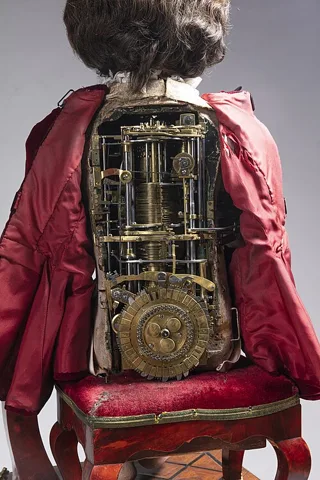

The Writer, the Draughtsman and the Musician are presented to the public in La Chaux-de-Fonds. Complex movements are built into their watchmaking mechanisms.
How it works and historical significance
The Writer can compose texts through mechanical setting; the Draughtsman executes predefined drawings. This is mechanical programming, without a computer. These works show how a sequence of gestures can be organized before electronics.
The Marquis and parlor automata
Maison Roullet-Decamps; Émile Louis Jumeau
France
Original illustration accessible in the sources
The museum preserves Le Marquis, dated 1880–1890. Parlor automata embody a culture of miniature spectacle: articulated characters, movements and watchmaking craftsmanship.
How it works and historical significance
This milestone illustrates the spread of animated mechanisms in the 19th century. A catalog date describes this specific object: it is not the invention date of all mechanical toys.
1930–1960 · The appearance of robot toys
Sheet metal, springs and batteries bring robots into homes.
Lilliput Robot
Manufacturer not established in the retained source
Japan
Original illustration accessible in the sources
This small tin wind-up robot is among the earliest known robot toys. SFO Museum dates it to 1938, with cautious wording about its status as the first example.
How it works and historical significance
A spring transmits its energy to a walking mechanism. It does not perceive its environment. The exact dating and attribution deserve a collector's caution: this sheet does not claim a definitively established "first robot".
Japanese tin robots
Several Japanese manufacturers
Japan
Original illustration accessible in the sources
Lithographed sheet metal gives the toys a futuristic look. Springs gradually appear alongside battery-powered motors: walking, turning and lighting up become play effects.
How it works and historical significance
Science fiction and the space age imagination provide a cultural context. A battery-powered motor is electric; that alone does not prove the presence of control electronics, sensors or AI.
Mr. Robot
Cragstan–Yonezawa
Japan
Original illustration accessible in the sources
The SFO Museum catalogue dates this battery-operated toy to 1960. Its robot-like appearance illustrates the rise of animated machines intended for the general public.
How it works and historical significance
Electric energy extends movement compared with a spring. In the filter, it joins the electric/electronic family; this category does not mean it has a processor or autonomous intelligence.
1970–1990 · Electronics and programming
We no longer just watch: we give instructions.
Big Trak
Milton Bradley
United States — British version illustrated
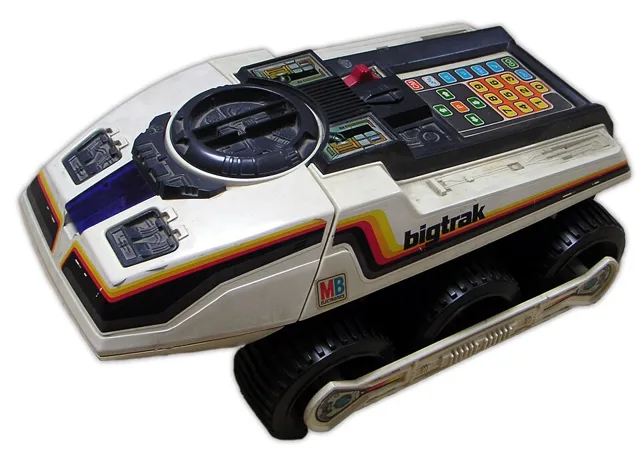

The player enters a sequence of orders on a keyboard located on the vehicle: move forward, turn, wait. The toy then carries out the course in the real world.
How it works and historical significance
The sequence becomes a program that the child can test and correct. This vehicle is not autonomous in the sense of navigation decided from perception of the environment.
Omnibot
TOMY
Japan
Original illustration accessible in the sources
A remote control operates this playful domestic robot. Its cassette player can record and play back commands, sounds and movements.
How it works and historical significance
TOMY places the launch of the range in 1984. The release date used here follows the manufacturer's history. Playing back a cassette is not learning through AI.
Transformers: the imagination of robots
Hasbro, based on Takara ranges
United States / Japan
Original illustration accessible in the sources
Transformers figurines popularize characters capable of changing from a robot form to a vehicle or object form. The brand was launched by Hasbro in 1984.
How it works and historical significance
The transformations of the classic figurines are done by hand. A fictional character or an articulated figurine is not, for that reason alone, a functional robot. This milestone is cultural, distinct from technical progress.
R.O.B.: a physical play partner
Nintendo
Japan
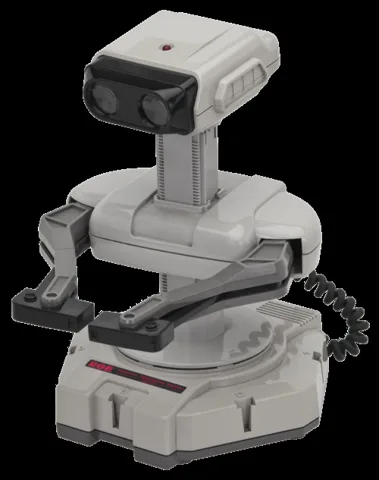

Nintendo launches R.O.B. as an accessory for the NES in 1985. Video games find a material extension with a small motorized partner.
How it works and historical significance
The date concerns the original robot accessory. The amiibo released in 2015 and the video game character are other objects: the amiibo figurine does not reproduce the operation of the 1985 robot.
1990–2010 · Companions and educational robots
Sensors and construction transform the relationship with the toy.
Furby: the interactive companion
Tiger Electronics / Hasbro
United States
Original illustration accessible in the sources
Furby made its appearance in 1998. The look of a creature and the toy’s reactions establish a new emotional relationship with an electronic object.
How it works and historical significance
The different generations do not have the same capabilities. Vocabulary changes or scripted responses do not, by themselves, prove machine learning. One must distinguish programmed behavior from AI.
LEGO MINDSTORMS: build then program
LEGO, in collaboration with MIT
Denmark / United States
Original illustration accessible in the sources
The MINDSTORMS system went on sale in 1998. Bricks, motors, sensors and programming make it possible to build several machines with a single set.
How it works and historical significance
The robot is no longer simply bought finished: it is assembled and its behavior is designed by the user. The link between hardware construction, algorithms and experimentation opens up a lasting educational path.
AIBO ERS-110
Sony
Japan
Original illustration accessible in the sources
Sony announced AIBO on 11 May 1999; sales began on 1 June. This robotic dog combines mobility and autonomous behaviors for home entertainment.
How it works and historical significance
Its sensors and behaviors create an interaction with the physical world. The motion software also makes it possible to design sequences. This specialized AI does not correspond to today's large conversational models.
Robosapien
WowWee
Hong Kong
Original illustration accessible in the sources
Launched in 2004, Robosapien features a motorized humanoid with sensors and expressive movements. The remote control gives the player command of the actions.
How it works and historical significance
WowWee emphasizes its biomorphic locomotion and its sensors. Programmed sequences and reactions make play lively; spectacular behavior still does not suffice to establish general AI.
2010–2020 · Connected robots
The smartphone becomes a controller, a workshop and sometimes a dependency.
Sphero Original
Orbotix, which became Sphero
United States
Original illustration accessible in the sources
A small robotized sphere is controlled from a mobile device. The smartphone becomes the piloting interface and, depending on the software used, the programming interface.
How it works and historical significance
Internal motors make the shell roll. The 2011 Original model uses classic Bluetooth. Its historic app is no longer available for download: software dependency is part of the history of these toys.
Dash and Dot
Wonder Workshop
United States
Original illustration accessible in the sources
The robots went on sale in December 2014. Dash moves around; Dot serves as an interactive companion. Apps make it possible to create behaviors with blocks.
How it works and historical significance
Sensors link the program to the environment. The connection with a mobile device is made via Bluetooth; “connected” does not necessarily mean a permanent link to the Internet. Dot is not a rolling robot like Dash.
Cozmo
Anki
United States
Original illustration accessible in the sources
Cozmo combines perception, games and expressive animations. Carnegie Mellon documents its launch planned for autumn 2016 and its use in teaching cognitive robotics.
How it works and historical significance
The robot makes it possible to explore AI algorithms and programming. Its expressions are an interface designed by humans: they demonstrate neither lived emotions nor consciousness.
aibo ERS-1000: the companion's return
Sony
Japan
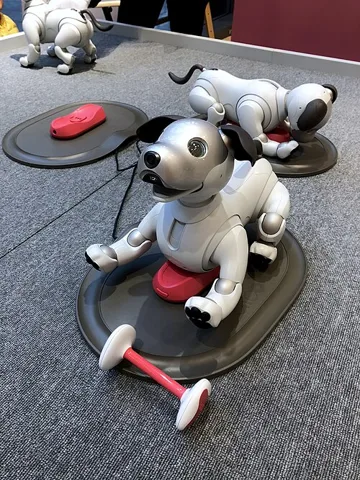

Sony relaunched aibo in Japan in January 2018. This new generation renews the robotic dog experience, nearly twenty years after the ERS-110.
How it works and historical significance
The photograph shows the ERS-1000, not the 1999 model. The comparison between generations reminds us that a single trade name can cover different hardware, software and services.
2020–2026 · Robots and artificial intelligence
Learning with robots, but also understanding their limits.
LEGO Education SPIKE Prime
LEGO Education
Denmark
Original illustration accessible in the sources
After a presentation in 2019, the worldwide launch took place on 14 January 2020. A hub, motors and sensors accompany block-based programming inspired by Scratch.
How it works and historical significance
This landmark concerns the release, distinct from the announcement. This educational kit makes it possible to assemble robots; the presence of sensors does not automatically make every construction an AI system.
Sphero indi: programming with colors
Sphero
United States
Original illustration accessible in the sources
indi offers an entry into computational logic without a screen: the color tiles steer the robot’s behaviors. An app then allows progression toward blocks.
How it works and historical significance
A command can take the form of a physical object rather than text. This approach makes sequences visible; it does not in itself constitute learning through AI.
Miko 3: the conversational interface
Miko
India
Original illustration accessible in the sources
The manufacturer opened pre-orders on 12 October 2021, for shipments announced in November. The robot highlights voice interactions and content intended for children.
How it works and historical significance
The AI capabilities are described here as functions announced by Miko, not as independent proof of educational effectiveness. Connection, subscriptions, languages and available services must be verified before use.
Furby: a new generation
Hasbro
United States
Original illustration accessible in the sources
Hasbro announced the new Furby on 22 June 2023, with sounds, lights and many responses. The interactive companion remains a major toy format.
How it works and historical significance
It should not automatically be attributed generative AI because it speaks or reacts. The features must be evaluated for this specific generation, based on the product documentation.
LEGO Education Computer Science & AI
LEGO Education
Denmark
Original illustration accessible in the sources
Announced on 12 January 2026, with shipments announced from April, this solution combines bricks, interactive hardware and activities on computer science and AI.
How it works and historical significance
The goal is also to learn how AI works, not just to give the child an “intelligent” robot. LEGO states that Coding Canvas does not require a student connection and keeps data locally. The announcement date is separate from the shipping schedule.
Same appearance, different technologies
These categories are a reading guide, not exclusive boxes. To identify a robot, look at what it actually does, with which sensors and under what control.
Mechanical toy
A spring, a cam or a gear transmits movement. It can be ingenious without a sensor or computer.
Electric or electronic toy
A battery powers a motor; electronics can add sounds, lights or control logic. Electric and electronic are not synonyms.
Remote-controlled robot
The user chooses the actions remotely. The remote control can be infrared, radio or an app.
Programmable robot
The user defines a sequence of actions or rules. The program can use sensors, without necessarily using AI.
Autonomous robot
Within the limits of its task, it acts without continuous human command and adapts some actions to its measurements. Autonomy does not mean unlimited freedom.
Robot using AI
Some functions rely on AI techniques: perception, learning or language processing. An expressive face is not proof of it.
Fictional character and figurine
A cartoon hero or a transformable figurine is not a functional robot. The imagination remains a cultural chapter in its own right.
Connected robot
It exchanges with a device or a service. The link can be local via Bluetooth or go through the Internet; it proves neither autonomy nor AI.
When play becomes a collective challenge
RoboCup and RoboCupJunior
The first official RoboCup was held in 1997 in Nagoya, Japan. The Junior initiative began with a demonstration in Paris in 1998, then a first international educational competition in Melbourne in 2000. Designing, programming and testing a robot becomes a team project.
FIRST LEGO League
FIRST and LEGO launched a pilot program in 1998. The challenges combine construction, programming and cooperation. Hardware, formats and participation conditions evolve: check with the organizer for the relevant season.
2020–2026: talking with a robot is not enough
Conversational interfaces broaden interactions, but speech recognition, preprogrammed responses and text generation are different techniques. A robot can make mistakes, depend on a remote service or lose functions when its app disappears.
The educational benefits must be evaluated beyond commercial promises. A specialized AI system is neither a consciousness nor an infallible teacher.
Children's data: the questions to ask
- What sounds, images or identifiers are collected? Do they stay on the device or are they sent to a server?
- Can you control pairing, install updates and disable unneeded functions?
- Can you view and delete the data? How long will the services be maintained?
- Does the robot still work without an account, the Internet or a subscription?
The CNIL recommends securing access, limiting the information provided and turning off the toy when it is not in use. The applicable rules and the product manual remain to be checked for each use.
And tomorrow?
Future generations could better perceive their environment, program themselves more naturally and remain useful longer. For NewsRobotique, progress is also measured by repairability, software maintenance, the protection of children and what the player actually learns.
These leads are perspectives, not predictions. The story continues with verifiable objects, observed uses and accessible sources.
Sources and methodology
Priority given to museums, manufacturer archives, universities and organizers. The dates correspond to the milestone indicated; “circa” signals cautious dating. Manufacturers’ statements describe their products and are not an independent evaluation of their educational performance.
The reused photos are photographs of historical objects, sometimes taken long after their launch. Each credit refers to the file and its license. No generated image is presented as a period photograph. For the other objects, the sources give access to the original illustrations, whose reproduction has not been authorized here.
- Musée des Arts et Métiers — Vaucanson file
- Musée d’art et d’histoire — The Draughtsman
- Jaquet Droz — the automata
- Musée des Arts et Métiers — Théâtre des automates
- SFO Museum — Japanese Toys!
- Museums Victoria — bigtrak, 1979
- Computer History Museum — Big Trak
- TOMY — Omnibot history, p. 3
- The Strong — history of the Transformers
- Nintendo — R.O.B., 1985 accessory
- Hasbro — Furby’s return, 1998 history
- LEGO — history of LEGO Education
- Sony — launch of the ERS-110, May 1999
- Sony — 25 years of AIBO and return in 2018
- WowWee — company history
- Sphero — Original (2011) and 2.0 (2013) models
- Sphero — how the robots work
- Wonder Workshop — launch in December 2014
- Wonder Workshop — robot resources
- Carnegie Mellon — Journey to Consumer Robotics, 2016
- Carnegie Mellon — Cognitive Robotics course, 2026
- LEGO — worldwide launch, 14 January 2020
- Sphero — indi, 2021
- Sphero — indi and the color tiles
- Miko — announcement of 12 October 2021
- Hasbro — new generation, 22 June 2023
- LEGO — Computer Science & AI, 12 January 2026
- CNIL — securing connected toys
- FIRST — history, 1998 pilot program
- RoboCup — first competitions of 1997
- RoboCupJunior — demonstration in 1998, competition in 2000
NewsRobotique · FJVR · Editorial method About Legal notice Contact