

When surgeons remove a rectal tumour, examination of the tissue provides an initial assessment. Finding out whether the cancer returns locally takes much longer. At Careggi University Hospital in Florence, Federico Passagnoli and colleagues combined these two kinds of evidence for 135 patients who underwent robot-assisted surgery.
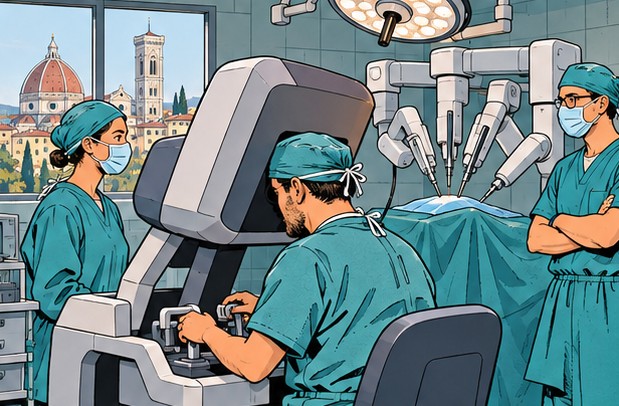
The team reviewed the records of 135 consecutive patients who underwent surgery between January 2018 and June 2024. The operation removed the tumour together with the mesorectum, the tissue surrounding the rectum. Microscopic examination shows how close the tumour comes to the outer edge of the removed tissue. This circumferential margin was reported as negative in 94.8% of patients.
What the follow-up records show
The records also showed what happened after surgery. A further operation was needed in 4.4% of patients. Over a median follow-up of 38 months, the team recorded local recurrence in 6%. This figure describes how often the cancer came back in the area of the original operation during follow-up.
Published in Updates in Surgery on 11 November, the results document several years of practice at one hospital. All patients underwent robot-assisted surgery. A comparison with another technique would be needed to determine how much the robot contributed to these outcomes.