History of military and security robotics
From the remote control to AI systems: understanding machines, their uses and the place of humans, from 1898 to 2026.
Observing, transporting, rescuing, clearing mines: defense robotics is not limited to weapons. This history distinguishes prototypes, trials and operational uses, without confusing autonomy of movement with the decision to use force.
Documentation verified on 11 October 2026 · Educational selection, non-exhaustive · The dates indicate the milestone described.
The filters overlap. “AI / autonomy” also includes programmed navigation and research on autonomy: this filter does not mean that every system uses AI.
1898–1918 · Remote command
The first trials separate the operator from the machine. Radio control and preset guidance are two distinct paths.
Nikola Tesla's boat
Nikola Tesla
United States · inventor born in present-day Croatia
Milestone: Demonstration
A miniature boat receives commands by radio: a founding demonstration of wireless control.
Learn more: operation and importance
The operator directs the machine from outside. This is neither an autonomous boat nor an AI; the innovation lies in the transmission of instructions. The Tesla Museum keeps a reconstruction of the device.
Aerial Target
Archibald Montgomery Low and British team
United Kingdom
Milestone: Trial
British trials of pilotless aircraft explore radio steering.
Learn more: operation and importance
The Smithsonian places a first radio-controlled flight by Low's team in March 1917. These attempts ran into reliability problems: experimental proof is not an operational service.
Kettering Bug
Charles F. Kettering · Dayton-Wright
United States
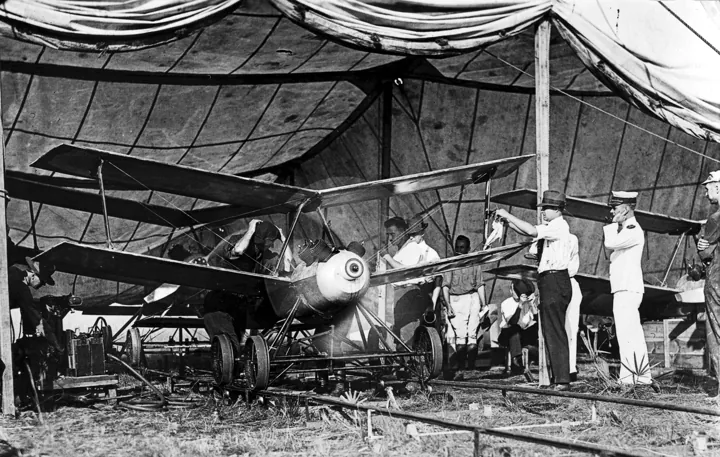

Milestone: Prototype with no use in combat
This experimental aircraft follows settings prepared before departure, with no pilot on board.
Learn more: operation and importance
Designed in 1917, the Bug was tested during the First World War. Its pneumatic and electric controls execute a predefined plan. Fewer than fifty units were produced before the armistice; it was not used in combat.
1939–1945 · First operational uses
Crewless vehicles move from the laboratory to certain operations. The human remains in control in the examples presented here.
Goliath
Borgward · variants produced with other industrial companies
Germany
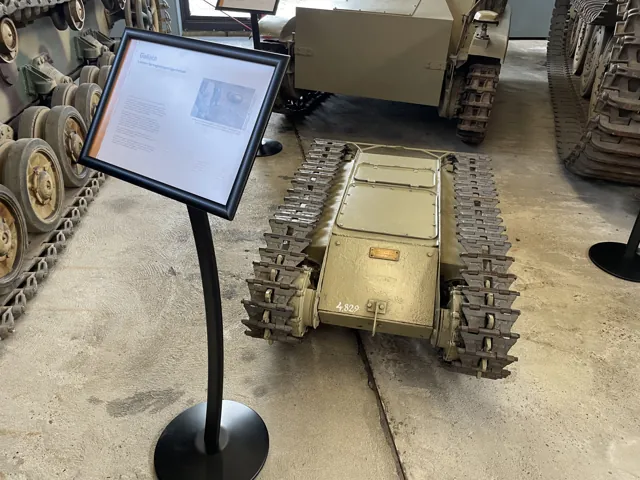

Milestone: Wartime production and use
A small tracked vehicle can be steered remotely by an operator connected by cable.
Learn more: operation and importance
The Polish Army Museum dates the trial series to April 1942 and production to May. Later versions appeared in 1943. This was a single-use demolition weapon, not an autonomous mine-clearing robot. Its history also shows the limits of a vulnerable physical link.
TDR-1
Interstate Aircraft · US Navy · RCA
United States
Milestone: Limited operational use
A camera transmits the forward view to an operator who controls the aircraft from another plane.
Learn more: operation and importance
Preparation was completed at the end of 1942, but documented operational use began in September 1944 in the Pacific. Television adds remote perception to radio control. This device remained piloted by a human.
1945–1989 · Observing and intervening
Aerial reconnaissance, underwater recovery and mine clearance build lasting uses: seeing or acting at a distance from danger.
Reconnaissance Firebee
Ryan / Teledyne Ryan · US Air Force
United States
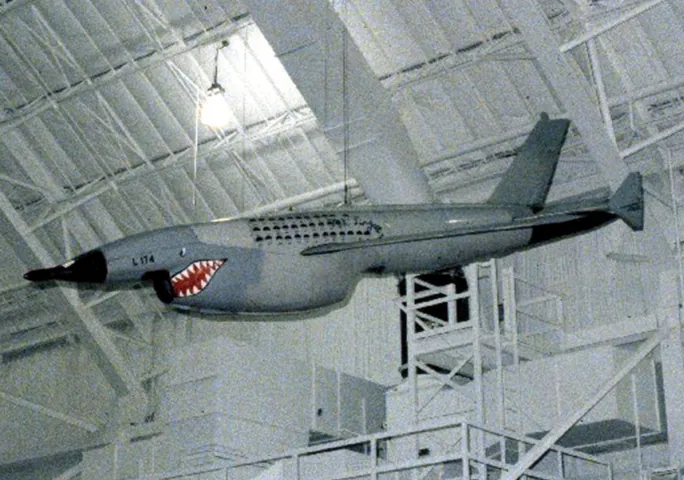

Milestone: Operational missions
Variants of the Firebee target drone became reconnaissance and intelligence-gathering aircraft.
Learn more: operation and importance
The Lightning Bugs were used between 1964 and 1979 according to the National Academies synthesis. Functions and modes of control vary by version; the same level of autonomy must not be attributed to the whole family. The aircraft could be recovered for new flights.
CURV: intervening underwater
Naval Ordnance Test Station · US Navy
United States
Milestone: Real recovery
The underwater robot CURV took part in the recovery of a bomb lost in the Mediterranean after the Palomares accident.
Learn more: operation and importance
The Office of Naval Research reports the 1966 intervention. The vehicle, initially intended to recover test equipment, combines a camera, tools and remote control. Its historical interest lies in the ability to intervene without carrying a human on board the craft.
PAP 104
ECA · DGA
France
Milestone: Creation of the system
The self-propelled Poisson became a French landmark of anti-mine underwater robotics.
Learn more: operation and importance
ECA's annual report places the creation of the PAP 104 in 1970. Despite the word “self-propelled”, the robot does not decide its mission on its own: propulsion and remote control are different functions. Later developments of the family must not be confused with this first milestone.
Scout and Mastiff
IAI · Tadiran
Israel
Milestone: Surveillance and development
The small surveillance drones combine a television camera and transmission of information to the ground.
Learn more: operation and importance
IAI dates the Scout's entry into service to 1979. The Evergreen museum documents the Mastiff III's cameras and the American trials leading to the Pioneer. This card does not set a single launch date for all Mastiff variants. Real-time video transformed remote observation.
Wheelbarrow
British team · MVEE, then specialized industrial companies
United Kingdom
Milestone: Design and first uses
The mine-clearing robot moves the operator away from the suspicious object and sends images back to them.
Learn more: operation and importance
The RAF Museum dates its design to 1972 in response to the needs of bomb-disposal teams in Northern Ireland. The first machine borrowed from an electric wheelbarrow; later generations use tracks. The protection of the specialist became a central function of security robotics.
RQ-2 Pioneer
Pioneer UAV · AAI / IAI lineage
United States / Israel
Milestone: Deployment
The Pioneer enters deployment for observation and surveillance missions.
Learn more: operation and importance
The National Academies synthesis indicates a first deployment in 1986. It links an aircraft, its sensors and a ground station. The milestone concerns the operational system, not a modern AI capability.
1990–2000 · The era of networks and sensors
Navigation, data links and digital sensors enable longer missions. A remote pilot and a programmed flight do not play the same role.
RQ-1 Predator
General Atomics Aeronautical Systems
United States
Milestone: First flight
The first flight of July 1994 marks a milestone for long-endurance observation drones.
Learn more: operation and importance
The initial contract is signed in January 1994 and production begins in August 1997 according to the USAF museum. The range of the links, navigation and sensors give the remote pilot a new continuity of observation. This initial RQ-1 must be distinguished from the armed versions that appeared afterwards.
RQ-4 Global Hawk
Northrop Grumman
United States
Milestone: First flight
A reconnaissance aircraft executes flight missions prepared in advance under human supervision.
Learn more: operation and importance
The USAF museum dates its first flight to 1998 and describes the pre-programmed missions as well as the digital and infrared sensors. Navigation autonomy concerns flight; it does not mean autonomous target selection nor any necessary use of AI.
2000–2010 · Protecting teams on the ground
Mine-clearing robots spread through conflicts; research challenges meanwhile explore autonomous driving.
PackBot in Afghanistan
iRobot · US forces
United States
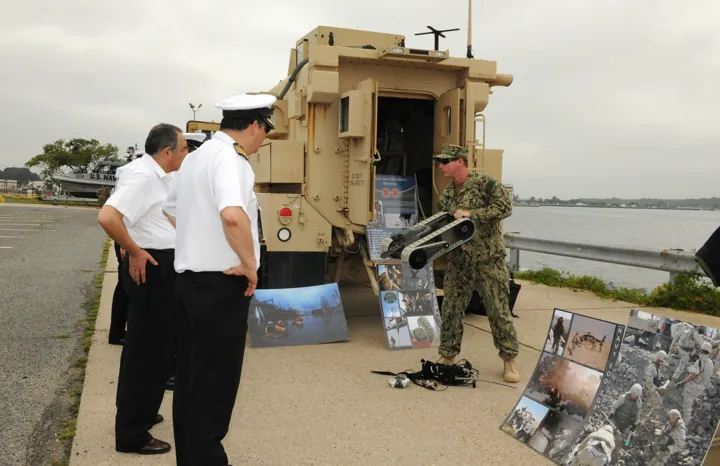

Milestone: Documented use
Compact exploration and mine-clearing robots accompany teams on the ground.
Learn more: operation and importance
The US Army reports the presence of the PackBot in Afghanistan since 2002. The camera and the arm make it possible to see and manipulate at a distance. The photo shown dates from 2012: it illustrates the PackBot family, without claiming to show its first deployment.
DARPA Grand Challenge
DARPA · university and industry teams
United States
Milestone: Research competition
After the collective failure of 2004, five vehicles finish the 2005 autonomous driving event.
Learn more: operation and importance
The competition of October 8, 2005 is won by the Stanford team. Perception and planning must enable vehicles to progress without a driver. It is a research accelerator whose benefits extend beyond defense; this result does not prove an aptitude for all military situations.
TALON in Iraq
Foster-Miller
United States
Milestone: Documented use
The TALON becomes a major example of an intervention robot used near suspicious objects.
Learn more: operation and importance
The US Army documents its use in Tikrit in 2005. The robot has tracks, cameras and an arm controlled remotely. The reduction of human exposure here comes from teleoperation, not from an autonomous decision to neutralize. The milestone corresponds to the cited use, not to the date of invention.
Harfang
EADS · IAI · Armée de l’Air
France / Israel
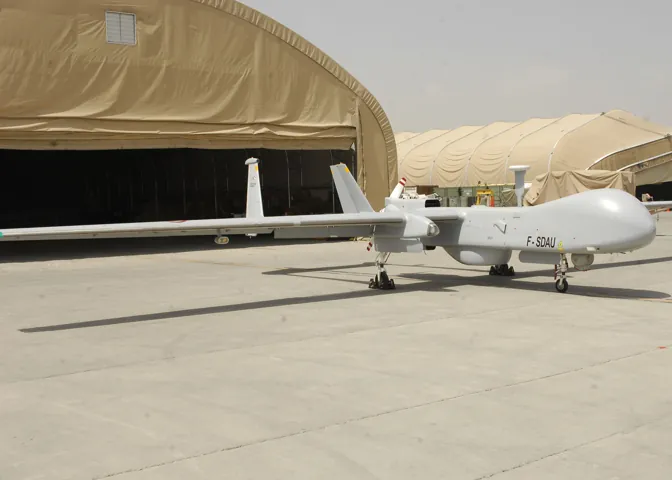

Milestone: French first flight then operations
First flight at Istres in September 2006; first operational deployment in Afghanistan in February 2009.
Learn more: operation and importance
The official retrospective highlights the transmission of images to command centers and combatants. Harfang subsequently contributes to surveillance missions over French territory. The flight date and the date of first operational use are deliberately kept separate.
DARPA Urban Challenge
DARPA · Carnegie Mellon and other teams
United States
Milestone: Research competition
Vehicles must operate in an urban environment with traffic rules and other road users.
Learn more: operation and importance
Teams work on perception, decision-making and maneuvers in an organized setting. Tartan Racing's victory extends the desert challenges. We move from following a route to interacting with a more complex environment, without confusing a test track with free-flowing traffic.
2010–2020 · Sharing tasks with the machine
Assisted mobility, perception and human-machine collaboration progress. These demonstrators did not all become standard equipment.
LS3: the pack robot
DARPA · Boston Dynamics
United States
Milestone: Prototype
An experimental quadruped follows a team and carries part of its load.
Learn more: operation and importance
The first outdoor test cited by DARPA took place in January 2012. The system combines locomotion, perception and interaction with users. LS3 is presented here as a support demonstrator; this card does not attribute to it a widespread deployment or the status of an autonomous weapon.
Robotics Challenge: intervening in disasters
DARPA · international teams
United States · international participants
Milestone: Research final
Robots take on movement and manipulation tasks in a disaster scenario.
Learn more: operation and importance
The June 2015 finals illustrate the difficulties of manipulation, mobility and human-machine links. The program supports intervention in dangerous environments, notably for rescue; defense funding does not make it a combat robot competition.
Sea Hunter
DARPA · Leidos · Office of Naval Research
United States
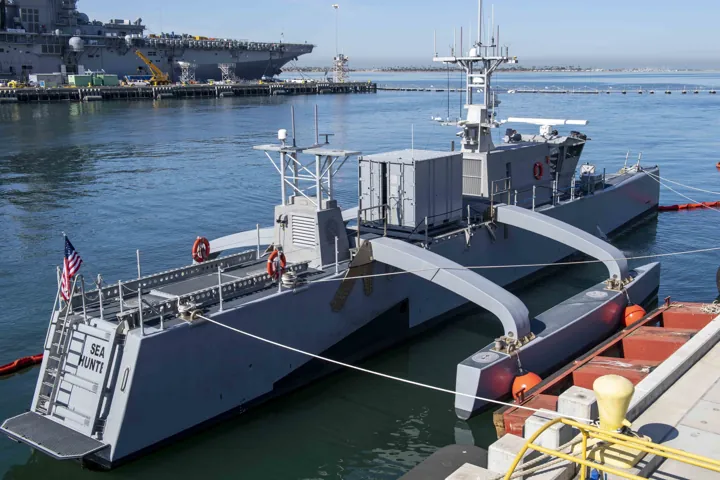

Milestone: Trials then program transfer
The crewless vessel is tested at sea from 2016, then its development is transferred to ONR in 2018.
Learn more: operation and importance
Sea Hunter explores prolonged navigation and compliance with maritime rules. The transfer continues the maturation of the prototype: it is not proof of all the missions envisaged. The photograph dates from 2022 and shows the vessel docked, several years after the first trials.
FURIOUS: teammate robots
DGA · Safran · Effidence and partners
France
Milestone: Research project and demonstrators
The DGA entrusts a ground robotics project intended to study the help that robotic teammates can provide.
Learn more: operation and importance
The contract is won at the end of 2017 and announced in January 2018. A new phase follows in June 2022. FURIOUS concerns the study, development and evaluation of demonstrators: it does not constitute the announcement of a fully autonomous operational unit.
2020–2026 · Autonomy, AI and field limitations
AI experiments sit alongside largely teleoperated operational uses. This section stops at information verified as of October 11, 2026.
OFFSET: experimenting with a swarm
DARPA · research teams and integrators
United States
Milestone: Last field test
Aerial and ground vehicles are evaluated together to explore interactions within a swarm.
Learn more: operation and importance
The final FX-6 test takes place in 2021. Coordination functions, interfaces and field constraints remain research topics. A swarm demonstration proves neither a common military deployment nor an autonomous lethal decision capability.
CoHoMa: learning to collaborate
Battle Lab Terre · AID · participating teams
France
Milestone: Exploratory challenges
Teams put their ground and aerial systems to the test in field scenarios.
Learn more: operation and importance
The first edition prepares reconnaissance missions in May 2022; the second explores a different scenario in 2023. The stakes concern operator workload and organization as much as technical capabilities. Teams test solutions, they do not demonstrate uniform total autonomy.
ACE: AI in a test aircraft
DARPA · US Air Force · partners
United States
Milestone: Supervised trials
AI algorithms control the X-62A VISTA during experimental aerial scenarios.
Learn more: operation and importance
DARPA describes trials in 2023 continued in 2024. The milestone concerns piloting and maneuvers in a test framework. It does not demonstrate that an AI alone decides on the use of a weapon; the trials are not an operational engagement.
Manta Ray
DARPA · Northrop Grumman
United States
Milestone: Prototype tested at sea
The underwater prototype carries out full-scale tests off the coast of California.
Learn more: operation and importance
The February and March 2024 tests explore the vehicle's propulsion, handling and capabilities. This system aims at prolonged underwater operations; the program's prospects are distinguished from what was actually tested.
SLAM-F: new underwater generation
DGA · Thales · Exail
France
Milestone: Order, future deliveries
France officially confirms in November 2024 the acquisition of eight new-generation underwater drones.
Learn more: operation and importance
The DGA then indicates first deliveries planned for 2028. The system combines navigation, sonar and processing of observations for mine warfare. An order does not mean that these new systems are already operational in 2024.
Ukraine: robotic logistics
Ukrainian forces · Ukrainian manufacturers, including SIRKO
Ukraine
Milestone: Uses reported by a party to the conflict
Ground robots are used for transport and certain evacuation or engineering missions.
Learn more: operation and importance
The Ukrainian ministry documents SIRKO-S1 in March 2025 and reports more than 7,000 robotic missions in January 2026, mainly logistics. This figure is attributed to its official source, without independent verification on this page. The use of a robot does not prove decision-making autonomy; communications, terrain and reliability remain decisive.
CoHoMa 4: continuing the evaluation
Armée de Terre · Battle Lab Terre · AID
France
Milestone: Challenge announcement
The fourth edition explores the collaboration of ground and aerial systems and their real-world constraints.
Learn more: operation and importance
The 2026 presentation distinguishes CoHoMa from the goals of the Pendragon project. Mobility, beyond-line-of-sight teleoperation, endurance and perception are evaluation axes. The announcement is a research milestone; this page does not turn future goals into acquired capabilities.
SLAM-F: continuing the equipment
DGA · Marine nationale · program manufacturers
France
Milestone: Order
The DGA orders twelve additional surface and underwater drones as well as the chartering of carrier vessels.
Learn more: operation and importance
This milestone concerns an order, announced by the DGA in 2026. It continues the transformation of mine countermeasures and the ability to operate at a distance from the dangerous zone. Deliveries and operational availability must be verified separately for each system.
The French trajectory
Three threads intersect: mine warfare, aerial surveillance and ground research. The DGA, the forces, manufacturers and academic teams intervene at different stages.
1970 · The long time under the sea
The PAP 104 writes ECA and the DGA into the history of anti-mine underwater intervention. Teleoperation makes it possible to keep personnel away from dangerous objects.
2006–2009 · Observing from the air
The Harfang illustrates another line: an aerial system combining aircraft, sensors, links and ground teams. The French first flights precede the deployment in Afghanistan.
2017–2022 · Evaluating ground teammates
FURIOUS structures research on platforms, autonomous mobility and support for the combatant. The DGA and manufacturers test functions, with a new phase in 2022.
2022–2026 · The human in the system
The CoHoMa challenges examine cooperation, interfaces and field constraints. The link with the modernization of the Armée de Terre plays out in needs and integration: SCORPION does not mean that all vehicles are autonomous robots.
2024–2026 · Renewing mine countermeasures
The SLAM-F orders combine surface drones, underwater vehicles and carrier vessels. Acquisition announcements, planned deliveries and actual uses constitute different milestones.
Six families to read the uses
Ground · UGV
Wheels, tracks or legs: reconnaissance, transport, intervention and sometimes armed functions. The shape of the chassis does not say who makes the decisions.
Aerial · UAV
Drones can be remotely piloted, follow a programmed route or integrate perception functions. An aircraft without a pilot on board is not necessarily autonomous.
Surface and submarine · USV / ROV / AUV
A USV navigates on the surface. An underwater ROV generally remains connected to an operator; an AUV executes a mission with greater autonomy. Systems sometimes combine several vehicles.
Mine clearance and security
Cameras, sensors and manipulators are used to inspect a dangerous environment and keep teams at a distance. Their use also concerns civil security and rescue.
Support and logistics
Transporting equipment or contributing to an evacuation are missions distinct from the use of a weapon. Reliability and ergonomics matter as much as autonomy.
Collaborative systems
Several machines and operators exchange information and share tasks. A group of drones is not automatically an autonomous swarm.
Who decides? Understanding control
These four descriptions are an educational guide, not a universal standard or a certified scale. The same system can change mode depending on the task.
The human chooses the actions as the mission unfolds. The machine executes the commands.
Goliath, Wheelbarrow, EOD robotsA prepared sequence or route is executed within a defined framework.
Kettering Bug; pre-programmed flightSome tasks are delegated; the human defines the objective and supervises.
Assisted mobility, following a teammateThe system perceives and adapts actions without continuous command, within a limited domain of use.
Sea Hunter's experimental navigationAI is a technique; autonomy is a function
AI can help recognize an object, analyze images or propose a trajectory. A robot can be autonomous in its movement without modern AI, and use AI while remaining piloted. Navigation, perception, the selection of an objective and the application of force must be examined separately.
Law, ethics and responsibility
International humanitarian law applies to the use of weapons, including when they incorporate autonomous functions. Distinction between civilians and combatants, proportionality and precautions remain requirements; technology does not erase them.
Navigation autonomy ≠ autonomy of a weapon
The ICRC describes autonomous weapons as systems that select targets and apply force without human intervention in these functions. A mine-clearing robot or a remotely piloted drone therefore does not automatically fall under this description. Autonomy must be analyzed function by function.
What belongs to the rules and what belongs to the proposals
The ICRC recommends new binding rules: prohibiting unpredictable autonomous weapons and those designed or used to apply force against people, and strictly regulating the others. These recommendations must not be presented as a universal treaty already adopted.
In 2026, the group of experts of the Convention on Certain Conventional Weapons continues its work at the UN. A proposal, a working document and a legally binding text do not have the same status. The legal review of new weapons and human responsibility remain central questions.
What prospects?
The likely progress concerns reliability, supervision interfaces, mobility, communications and coordination. But a spectacular demonstration does not say how long a system remains useful, under what conditions, or with what responsibilities.
To follow the next steps, NewsRobotique will distinguish industrial announcements, orders, trials and documented uses. Questions of human control, traceability and the protection of people accompany technical progress; they do not come afterwards.
Sources, images and method
Documentary verification: October 11, 2026. Priority given to museums, public bodies, archives and program documents. Manufacturers provide information on their own announcements; ministries involved in a conflict are attributed sources, without any implied independent validation of their assessments.
The timeline is a selection, not a complete inventory. The dates refer to the events mentioned. The authentic photographs carry a credit, a link to the file and an indication of rights; some are taken long after the invention. The other cards use original educational pictograms and refer to the illustrated documents. No generated image is presented as a historical photograph.
The sources do not constitute an endorsement of the site by their organizations. The conditions of use and control may differ depending on the version of a system.
- Nikola Tesla Museum — radio-controlled boat, 1898
- Smithsonian — The Secret History of Drones
- National Museum of the USAF — Kettering Bug
- Polish Army Museum — Goliath
- National Naval Aviation Museum — TDR-1
- National Museum of the USAF — reconnaissance Firebee
- Office of Naval Research — Future Force, summer 2016
- ECA — 2004 annual report, history p. 9
- RAF Museum — Wheelbarrow, designed in 1972
- Israel Aerospace Industries — history, Scout in 1979
- Evergreen Museum — Mastiff III fact sheet
- National Academies — Uninhabited Air Vehicles, 2000
- National Museum of the USAF — RQ-1 Predator
- National Museum of the USAF — RQ-4 Global Hawk
- US Army — How many robots does it take?, 2018
- US Army — TALON and PackBot, 2008
- DARPA — Grand Challenge, 2004 and 2005
- DARPA — Urban Challenge, 2007
- Ministère des Armées — Harfang retrospective
- DARPA — LS3, January 2012 test
- DARPA — Robotics Challenge, disaster intervention
- DARPA — Sea Hunter, trials then 2018 transfer
- Safran — DGA FURIOUS contract, January 2018
- Safran — new FURIOUS phase, June 2022
- DARPA — final OFFSET test, 2021
- Armée de Terre — launch of the first CoHoMa
- Armée de Terre — CoHoMa 2, 2023
- DARPA — ACE, aerial trials 2023–2024
- DARPA — Manta Ray, 2024 tests
- DGA — order for eight AUVs, November 2024
- Ukrainian Ministry of Defense — SIRKO-S1, March 2025
- Ukrainian Ministry of Defense — January 2026 missions
- AID — CoHoMa 4 presentation, 2026
- DGA — SLAM-F order of July 21, 2026
- Armée de Terre — Robotization of the battlefield, 2026
- ICRC — autonomous weapons and humanitarian law
- ICRC — Autonomous Weapon Systems and IHL, selected issues
- UN — Group of experts on autonomous weapons, 2026 sessions
NewsRobotique · FJVR · Editorial method About Legal notice Contact