

During two weeks of trials off southern England, researchers fitted three instruments to the ALR1500 autonomous submarine to study marine life on the same dives. The University of Plymouth reported on the work on 29 October.
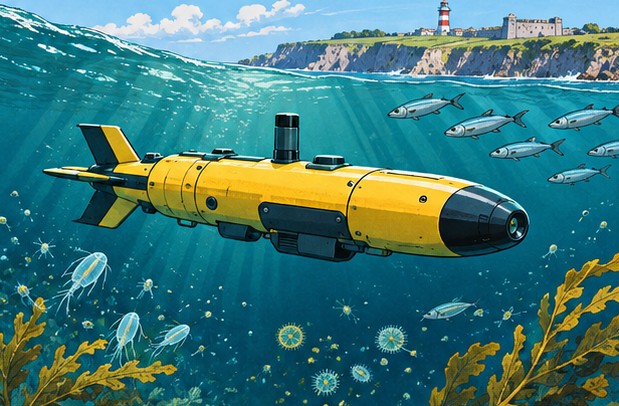
The instruments do different jobs. An echosounder sends out acoustic pulses and records echoes from fish and zooplankton. A hydrophone listens to sounds already present in the water. A third instrument captures holographic images of plankton. The submarine also takes its usual measurements, including water temperature and salinity.
Directing the dives from shore
The UK’s National Oceanography Centre supplied the submarine and the team operating it. From shore, operators could follow some of the data and adapt the mission in near real time. Satellite images helped them choose where to cross the boundary between two water masses. The onboard instruments then showed them what was happening below the surface.
During the trial the echosounder detected a shoal of fish. The team later observed common dolphins swimming alongside the vehicle. The two observations illustrate what researchers can document on a single outing. What drew the dolphins there remains an open question.
More extensive surveys are planned in the Celtic Sea in 2027 to study waters where floating wind turbines could be installed. One practical measure of the equipment’s usefulness at that scale would be the proportion of each dive for which all three instruments returned usable measurements at the same time.