

To teach a robot arm how to move a box, it helps to show it a movement it can reproduce. In a preprint dated 11 November, Kevin Avdiu and colleagues present RUMI, a handheld gripper that lets demonstrators see where the robot’s joints would need to go as they move.
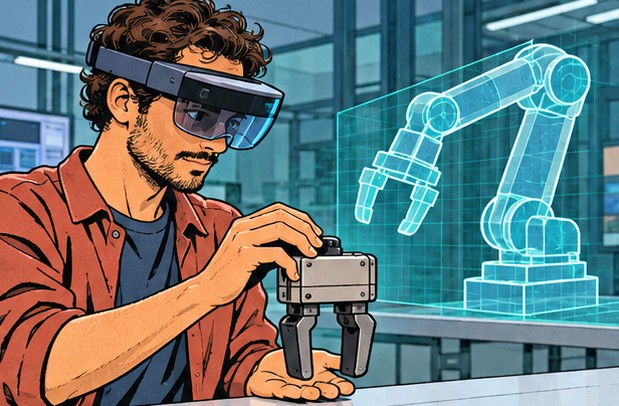
Imagine picking up a box from a table and setting it down a little further along. Your hand has plenty of freedom. A mechanical arm is fixed at the base, and each joint can travel only so far. With RUMI, the demonstrator holds a gripper and wears a headset. A virtual arm appears over the table and follows the gripper, showing what posture the real machine would have to adopt.
Five participants, 100 demonstrations
Five people with little experience operating a robot arm gave 20 demonstrations each. For ten demonstrations they could see the virtual arm and received guidance back to the starting position. For the other ten both aids were switched off. Of the 50 assisted trajectories, three included at least one movement beyond a joint limit. Without assistance, 16 out of 50 did.
The result suggests a way to improve examples for imitation learning, in which a robot learns from human demonstrations. Someone who spots an awkward posture can redo the movement before it enters the training set. This trial covered one task and introduced both aids together. Testing each aid separately could show which helps most. The researchers calculated joint-limit violations from recorded trajectories. Measuring any effect on workshop collisions would require observations of robots at work.