

In a Belgian greenhouse, two robots make the first pass down the tomato rows, and seasonal workers finish picking. In a warehouse in northern France, six robots fetch parts, and people finish the order. Reading back through the 29 stories in our robotics roundup, we found the same question cropping up under the sea and in the operating theatre. What changes for the person who takes over from the machine?
What the last picker sees
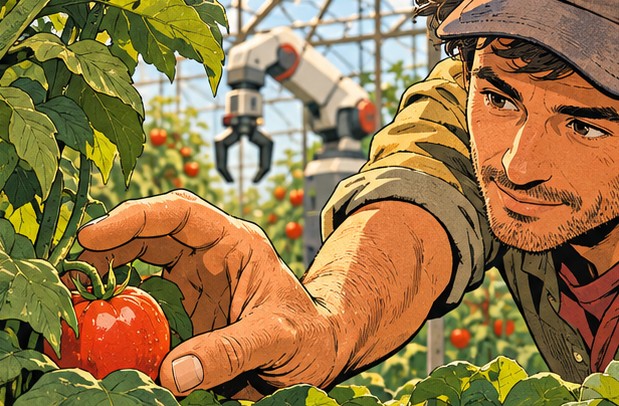
Near Mechelen, Jeroen Olbrechts tested two harvesting robots in the summer of 2026. They went first down his rows of small red tomatoes. By his estimate, they picked an average of one tomato in five. In his greenhouse, he put one robot’s picking rate at ten kilos an hour. A person could pick forty to fifty. He stopped the trial. Even so, he would consider another season if the robots became more reliable and better at choosing which tomatoes to pick.
Does picking one tomato in five save the seasonal workers a fifth of their day? That depends on the work left behind. They still have to walk each row, spot the ripe fruit on the vines and pick it. We have no figure for how long that second pass took. At Pont-Sainte-Maxence in northern France, the question works the other way round. At automotive recycler GPA, six robots carry bins of small parts to two order-picking stations. That saves warehouse staff the walk to the shelves. For the mechanic waiting on a part, the clock starts when the order is placed and stops when the part ships. Dematic, which installed the system, gives no figure for that interval.
What counts as 99 per cent success?
At the Novares plant in Seseña, Spain, a humanoid robot handled 207 parts during a demonstration, according to Innov8, the company that integrated it. Learning the task took eleven minutes. Preparing the project took three months. In its 17 November report, Novares put the robot’s success rate at 99.5 per cent for picking and placing parts and 95 per cent for handling boxes. The automotive supplier also reported 200 cycles in 60 minutes of autonomous operation. That gives the production team an initial figure to work with. How many parts could the robot handle over a full shift, including stops and restarts?
In Singapore, a nearly identical percentage measures something else. GlobalFoundries and Boston Dynamics report a 99 per cent mission success rate for two four-legged robots inspecting equipment at a chip plant. Since April, the robots have completed more than 90,000 checks. A single mission can include several of those checks. The Singapore figure describes inspection rounds, while the Spanish figure describes a pick-and-place task. What Singapore offers is a record of months of rounds at the same site. How many breakdowns those inspections have prevented remains an open question.
When keeping a human hand on the controls is the point
Off Santos, Brazil, on 7 November, researcher Oussama Khatib operated a valve twenty metres underwater while staying at the surface. His hands controlled the hands of the OceanOneK robot. Cameras gave him a three-dimensional view, and the controls let him feel contact with the valve. Keeping the researcher in control was the purpose of the trial. The system let him feel what he was handling at a distance. A future demonstration could show when that sense of touch helps him decide whether to continue a movement or stop.
In the operating theatre, too, a human team performs the procedure. In Florence, surgeons reviewed the records of 135 people who had robot-assisted surgery for rectal cancer. After a median follow-up of 38 months, they reported local recurrence in 6 per cent of patients. Those years of follow-up reveal an outcome that matters to patients long after they leave hospital. Everyone in the study had robot-assisted surgery, so how much the technique contributed remains an open question.
What to ask before the next trial
These trials suggest a simple way to plan the next one. Before switching on the robot, ask the people who will work with it what would make their day better. A picker might want to spend less time looking for missed fruit. A maintenance crew might value an early warning that lets them repair a machine before it stops. Each answer calls for a different measure. Either could help a team decide whether to continue, change the trial or call it a day.
Back in Jeroen Olbrechts’s greenhouse, imagine you and the grower are deciding whether to try another season. What would you ask the last picker coming out of the row? The answer might tell the engineers what to change on the next robot.
Sources
- Belgium · Jerom Rozendaal’s interview with Jeroen Olbrechts, Onder Glas, 3 September 2026
- France · Dematic’s account of the GPA installation, 3 November 2026
- Spain · Novares announces the trial programme, 2 July 2026
- Spain · Innov8 reports on the Seseña demonstration, 16 November 2026
- Spain · Novares reports task-level results and trial duration, 17 November 2026
- Singapore · Joint release from Boston Dynamics and GlobalFoundries, 17 November 2026
- Brazil · Bruna Totaro, SENAI São Paulo, report published 16 November 2026
- Italy · F. Passagnoli and colleagues, Updates in Surgery, 11 November 2026 (abstract)